|
|
|
|
|
Dedicated to Hispanic Heritage and Diversity Issues |
|
Content Areas United States . . . 3 Surname Ramon 23 Galvez Project. . 26 Orange Co CA. . 28 Los Angeles, CA 32 California . . . 34 Northwestern US 42 SouthwesternUS 46 Sephardic . . . .50 Black . . . . . . . . .51 Indigenous. . . . . 52 Texas . . . . . . . . 53 East Mississippi .60 East Coast . . . . 66 Mexico . . . . . . . 72 Caribbean/Cuba 79 International . . . . 80 History . . . . . . . 87 Archaeology . . . 93 Miscellaneous . . 94 2003 Index Community Calendars Networking Meeting March 29th END |
|
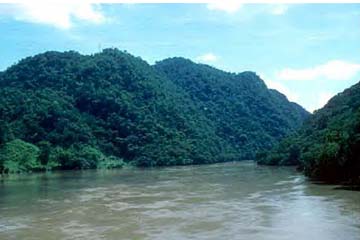
Many records and artifacts which give evidence of the cultural attainments of the peoples of the Americas are being lost through a global lack of awareness and respect for the indigenous in Spanish speaking nations. Plans are underway to build a dam of the Usumacinta river. Guatamalan and Mexican archeologists say this will potentially destroy 7th century Maya records. Go to the article on the templo de Quechula built by the Spanish. The church was built soon after the arrival of the Spanish in 1524. It was flooded by modern means, but sometimes during dry seasons the structure can be seen and even visited. |
|
|
| With sincere thanks to the many letters of support and contributions made by readers. It is the continuing submissions that increases the historical understanding that we all seek. Everyone is invited to participate by sharing articles, tidbits, happenings, and your own personal perspectives. Please send contents in an email, not attached, or mail: P.O. Box 490, Midway City, CA 92655-0490 |
| Somos
Primos Staff Mimi Lozano, Editor Associate editors: John P. Schmal, Johanna De Soto, Howard Shorr, Armando Montes, Michael Stevens Perez Contributors: Rene Aguilera Edward Allegretti Yolanda Alvarez Joseph Bentley Sonia Eddings Brown Bill Carmena Raul Damas |
Hector
Flores Lorraine Frain Anthony Garcia George Gause Albert Seguin Gonzales Jose O. Guerra, Jr. Daniel Gutierrez Elsa Pena Herbeck Walter Herbeck Paula J. Hinkel Granville W. Hough, Ph.D. Dr. Rowland R. King Cindy LoBuglio Wendy Maldonado Michael R. Hardwick Ana Carricchi Lopez Ana Maria McGuan |
Daniel
P. Mejia Armando Montes Col. Ernest Montemayor Donna Morales Gloria Oliver Richard D. Olquin Frances M. Palacios Joseph Puentes Lorraine Quiroga Viola R. Sadler Jose Salinas Dr. Susan Sanchez-Casal, Ph.D. John P. Schmal Howard Shorr Greg Smestad Scott Solliday Margarita Velez |
| Announcing
changes in the Board: Best wishes to Peter Carr and Gloria Oliver who are moving out of the country. We will miss them. Peter will be doing archeological research in Brazil, among some of the oldest human evidence in the world, estimated at between 40,000 and 50,000 years old. Gloria Cortinas Oliver will be leaving for a year and a half to serve a mission for the Church of Jesus Christ of Latter Day Saints in Puebla, Mexico. We will miss them both, but expect to get reports. Because of the increased activities with Bernardo de Galvez, and other commitments, we have increased our Board size, and are proud to welcome five new members to the Board, a group of very experienced researchers, and long time supporters of SHHAR and Somos Primos: Steven Hernandez, Henry Marquez, Crispin Rendon, Viola Rodriguez Sadler, and John Schmal. |
| 2003
SHHAR
Board Members : AAlphabetical by last surname....... Bea Armenta Dever, Diane Burton Godinez, Steven Hernandez, Mimi Lozano Holtzman, Henry Marquez, Carlos N. Olvera, Crispin Rendon, Viola Rodriguez Sadler, John P. Schmal, and Laura Arechabala Shane |
| Dame
Edna: Humor, Ridicule, or Racism? Chicken Soup for the Latino Soul Honoring POWs LULAC 74th Anniversary "Kingpin" Reinforces Negative Stereotypes Hispanic Babies top California state Births More Demographics Houston High School Drop Out Data Questioned Opiniones Latinas 'IMAGINE 2003' Latino Success Forum "Los Californios in Monterey: A Lost History" Road signs mark Spanish Explorer's Journey |
Wireless
Growth to Come from Hispanic Youths Hispanics being courted by NBA Ethnic Chasm Separates Factory Latino to Lead Immigration BureauNuestros Heroes, Best Spanish-Language Book SíTV, 1st American Latino TV Network in English National Historical Publications & Records Selective Service Records Story time, En Español Hispanic Outlook in Higher Education Internship Program Opens Doors For Hispanics |
| Dame
Edna: Humor, Ridicule, or Racism?
This Dame Edna issue provoked
considerable debate among Hispanics, should the affront be ignored or
not? A column in the Vanity Fair magazine, written by
an Australian female impersonator was extremely demeaning of all Spanish
speaking. Dame Edna explained that it was a joke, a satire. The
column appeared in Vanity Fair (February 2003), p.116, Ask Dame
Edna: Dear Dame Edna, Dear Editor, Wendy Maldonado [[ Editor's note: I agree with Wendy that these misguided humorists need to get an education. Their excuse for poor taste was that it was meant as a satire. Roget's International Thesaurus gives the synonyms of satire, as to ridicule, to lampoon. Lampoon means disparagement with humor. So by any definition, they wrote and did, what they meant to do, to demean Spanish speakers. They certainly were not cleverly subtle, a mark of higher levels of satire.]] |
Chicken Soup for the Latino Soul Have you written any personal family stories? Maybe they will fit the kinds of stories that Chicken Soup for the Latino Soul is seeking. Think of those special family stories and share. Go to: http://www.latinosoul.com Dr. Sánchez-Casal said she will be accepting stories until Summer 2003 (and perhaps beyond). So, if you have some stories that need a little work, fix them up and share your memories with the rest of us. Susan Sánchez-Casal, Ph.D. soup@latinosoul.com Co-author, Chicken Soup for the Latino Soul PO Box 247, Clinton, NY 13323 Phone: 315.859.4329 Fax: 315.853.8182 |
A Tribute to Mexican American Veterans: Honoring POWs of all Wars 7th Annual Veterans Day Celebration: On Saturday, November 8, 2003 at 10:00 a.m. Latino Advocates for Education, Inc. and California State University at Fullerton will host the 7th Annual Veteran's Day Celebration: A Tribute to Mexican American Veterans, at the CSUF campus. This year we will honor our POWs from all wars and conflicts. If you were a POW please contact us immediately. If you know someone who was a POW, please give us that person's name, address and telephone number and we will contact that person. Last year we honored over 200 Mexican American Korean War veterans. Over 1,000 persons attended our patriotic event. All POWs, regardless of ethnicity, are welcome to be honored. Obviously, as our organization is made up of Mexican American volunteers our focus is on honoring our Mexican American veterans who have not received the recognition for their brave and heroic service to our country. Latino Advocates for Education, Inc. P.O.Box 5846 Orange, Ca. 92863-5846 (714) 225-2499 |
League of United Latin American Citizens 74 Anniversary February 16, 2003 Dear LULAC Members and Friends: Seventy-four years ago the founders of the League of United Latin American Citizens created an organization that would revolutionize civil rights and community service for Hispanic Americans. It was an organization composed of volunteer members dedicated to gaining the same rights and opportunities for Hispanics as accorded to all other Americans. Since its founding, the members of LULAC have developed an extraordinary record of accomplishments. Our unprecedented achievements in education, employment, housing, civil rights, and economic development have improved the lives of millions of Hispanics throughout the United States. As members of LULAC, we are responsible and empowered to change our community through service and activism. As we work to secure our civil rights and improve our communities, we must draw strength from our proud record of accomplishments and the spirit of the founding fathers which still unites the LULAC of today. As we celebrate National LULAC week from February 16-22, 2003 let us remember the spirit and philosophy of the original LULAC members. Let us reflect on the dedication, pride, and ideals of the League and recommit ourselves to the notion that a people committed to the principals of equality and community service can create a fuller and richer civilization for our country. Yours in LULAC, Hector Flores, National President LULAC Code http://www.lulac.org/About/Creeds.html History of LULAC http://www.lulac.org/Historical%20Files/Resources/History.html LULAC: For Immediate Release - February 11, 2003: Hispanics remain severely underrepresented in the judiciary comprising only 3.8% of federal judges while making up 14% of the US population. |
LULAC Believes "Kingpin" Reinforces Negative Stereotypes of Latinos Sent by Howard Shorr howardshorr@msn.com LULAC is very disappointed with NBC's decision to air a new program called Kingpin. Aside from the fact that the program is violent, glorifies drug dealers and seems to have no social value, the program also reinforces negative stereotypes against Hispanics. Kingpin, which portrays Hispanics as drug dealers, murderers, and unpatriotic American citizens, opens the door to more negative feelings toward Latinos in our community. As it is Hispanics are increasingly the target of hate crimes and racial profiling. We are concerned that this program will only add to this wrongful treatment, said Hector Flores, LULAC National President. The program is aired at 10 p.m. when many children are still watching television and may lead many to associate Latinos with drug trafficking and other crimes. The fact is Kingpin is a reflection of the values of NBC and not those of the Hispanic community, states Flores. The vast majority of Hispanics are law abiding, hard working, patriots and their story is rarely portrayed on television. While LULAC appreciates that the program increases Hispanic representation at NBC both behind and in front of the camera, this inaccurate representation of Hispanics ultimately hurts the community. What is so difficult to swallow is that Latinos are barely on TV and when they are, they are usually in negative roles, such as criminals, added Flores. In fact a study released by Children Now, a child research and action organization entitled the Fall Colors Report for 2001-2002, found that 63 percent of the major networks feature Latino characters on prime-time programs who are either criminals, service workers, or unskilled laborers. Now more than ever immigrants are placed under intense scrutiny by others in America. The last thing Hispanics need is a program like this that reinforces negative stereotypes and teaches people to fear or hate Latinos, added Flores. We discourage corporations from advertising during this program hour. In addition, we are urging Hispanics to refrain from watching the program and purchasing products advertised on the show. I don't think corporate America wants to miss out on the Latino dollar, especially when our purchasing power is approximately $580 billion annually and growing, added Flores. The League of United Latin American Citizens (LULAC) is the oldest and largest Latino civil rights organization in the United States. LULAC advances the economic condition, educational attainment, political influence, health, and civil rights of Hispanic Americans through community-based programs operating at more than 700 LULAC councils nationwide. Lorraine Quiroga, Communications Manager League of United Latin American Citizens 2000 L Street, NW, Washington, DC 20036 tel: (202) 833-6130 fax: (202) 833-6135 www.lulac.org |
Extract: Hispanic babies top California state births UCLA study from 2001 says majority of newborns in California and in Orange County were Latino. By ROBERT JABLON The Associated Press LOS ANGELES – A university study released February 5th shows that for the first time in almost 150 years Hispanic babies account for more than half of all births in California - yet another milestone signaling that Hispanics will dominate the state's future. From July to September 2001, there were 138,892 births in California and 69,672, or 50.2 percent, were Hispanic, according to a recent review of birth certificate data by the UCLA Center for the Study of Latino Health and Culture. In Orange County during the same period, 50.6 percent of births were Hispanic, marking the first time it recorded more than half of all births as Hispanic as well. Hispanics make up about 31 percent of Orange County's overall population, according to the 2000 census. Statewide during the quarter studied by UCLA, non-Hispanic whites accounted for 31.4 percent of births, followed by 11.3 percent for Asians and Pacific Islanders and 6.1 percent for blacks. "The long-anticipated Latino majority has arrived," center director David Hayes-Bautista said. "In 2003, it is learning how to walk and will shortly learn to talk." The center's study, based on state health department statistics, confirms the ethnic shift that made 2001 the year that California officially lost its white majority. The U.S. census showed Hispanics made up nearly a third, while non-Hispanic whites slipped to less than half of the state's population of 33.9 million. It was the first time since the late 1850s that Hispanics were a majority of babies born. The percentage has been increasing for at least two decades, however. In 1980, it was 29 percent. The study also broke down Hispanic births by county, and Imperial County near the border with Mexico in the third quarter of 2001 had the highest percentage, 89.2. In Los Angeles, the figure was 63.5 percent. The small counties of Alpine and Sierra in Northern California had three births each, none of them to Hispanics.
|
Hispanic Demographics Highlights: Largest minority group - 42.6 million (PR included), increasing by 1.7 million a year. Purchasing power: $630 billion for 2002 equal to 9th largest economy in world. Youngest minority group: One of three under 18 - 44.7% under 9 years old. Cost of college a barrier: 2% decrease in total college enrollment http://www.hispanicvista.com/html2/020303dn.htm |
Houston High School Drop Out Data Questioned Source of the following three articles, HispanicVista.com On February 11, 2003 KHOU-Channel 11 aired a report in which Sharpstown High School employees reported to state officials that no students dropped out last year, this news report raises some serious questions about allegations on How HISD gathers and report the dropout rate. The disturbing part is that a Sharpstown employee, said employees knew that dropout information provided to the Texas Education Agency was false. A good question, is Sharpstown school the only school in HISD where administrators determined that 30 of the 1,705 students enrolled were not attending classes, and codes were assigned to each student documenting the reasons. How did the data disappear from the school's records, showing no dropouts ? And was a backup data in place? Why are some of the students interviewed disputing HISD records. LULAC and other community leaders have always believed that HISD drop out data has been questionable. Could it be that HISD refuse to acknowledge that it has a student push out problem? Media reports claim that for two years in a row, the TEA lowered the accreditation rating of the North Forest ISD in northeast Harris County because it had severely underreported its dropout rates. Will the incorrect data reporting lead to sanctions against HISD? What is the solution? Could the University of Houston, Texas Southern, and Rice University combine resources and conduct an independent audit on the HISD drop out problem? When will the statewide audit of dropout data, mandated by the Legislature two years ago be completed? When will the TEA new system for tracking schools' success in keeping their students in school will be in place? http://www.khou.com/news/defenders/index.html http://www.khou.com/news/defenders/investigate/khou030210_gs_defenders HISDdropouts.40a29881.html Channel 11 khou.com Defenders investigate HISD dropout rate . . .Are employees encouraged to lie about dropouts? By Anna Werner / 11 News Defenders 02/10/2003 HOUSTON (KHOU) -- The low dropout rate in the Houston school district has won it praise and even awards. But the 11 News defenders have discovered the numbers may be a lesson in lies because a lot more kids may be quitting classes than we know about. Many consider H ISD's dropout rate an education miracle. The district says it has fallen radically in the past eight years. Its latest figures show only one-and-a- half percent of HISD students leave school. That helped HISD win the $500,000 Broad Prize and get named the best urban school district in the nation. But some educators say they don't believe it and estimate as many as 40 percent of HISD students may be dropping out. So how does the district get its figures? Juana Juarez moved to Houston with her family from Mexico and started going to Sharpstown Senior High School. "I thought the school here would be the same as the school back home," she said. But the 11th grader got her first surprise when she was put into the 9th grade and held there for two years. "I felt bad because I didn't see the reason," said Juarez, whose grades were A's and B's. So Juarez finally decided part of her dream was over. She dropped out and took a job working the night shift at a local Wendy's. "I really don't like working there," she said. "I get very little pay. It's dangerous. A month ago they held us up. After five months, Juarez realized she made a mistake . "I'm not going to go anywhere with this job," she thought. "My dream finished when I got here." Juarez says she'd like to go back to finish school. But HISD records say she never dropped out of Sharpstown High School. Instead, they say she just transferred to a charter school in Alief. Juarez said she never told HISD that. So what's going on? High school dropouts are a hot topic lately. That's because dropouts pay a price in a hard life, a price that society often shares. So some school districts reward schools for keeping track of kids and keeping them in class because with high enough test scores and low dropout rates, employees get bonuses-- that means money for everyone from the janitor to the principal. But the Defenders have discovered that, unfortunately, some HISD schools seem more interested in cash than in the kids. And the kids are suffering. Some former employees told 11 News the school administrators didn't want it to look like their school had a lot of kids dropping out. Chris worked for more than a year at an HISD high school teaching predominantly Hispanic students. He says he saw something unusual happen far too many times. When one of his students wanted to drop out, a school counselor would come in with a document for the student. "They'd have to sign off at the bottom," he said. "And they were persuaded to sign off saying they were transferring to another district." By saying they were transferring, the student wouldn't count as a dropout. Chris said the school knew the students really weren't transferring. "There was nobody going to go check and see where 'Juan Garcia' went once he left. They see it as a victimless crime." Chris said. Sharpstown High School's dropout rate looks like a miracle. Last year, the school had more than 1700 students, many of them from lower-income homes. Yet, out of the 463 students that eventually withdrew, not one of them was considered a dropout. So Sharpstown Senior High had zero dropouts. "They seemed pretty happy to know there was zero percent dropouts when there wasn't," said Terry, a Sharps town employee who did not want his last name used. "A lot of the staff knew that those kids had really dropped out," he said. The Defenders obtained a dropout report for Sharpstown from early October with 30 students all considered dropouts. But three weeks . . . every single student had fallen off the list giving the school its zero dropout rate. How did it happen? "Technology," Terry said. "Everything can be done by computer." In fact, the Defenders have found that all 30 students had their codes for leaving school changed to codes that the state doesn't count as a dropout. Feb. 13, 2003, 10:56PM Subject of dropouts bedeviling HISD School board and consultant are uncertain how to track students, when to classify them By ZANTO PEABODY, Copyright 2003 Houston Chronicle The only thing certain about how many students drop out of Houston high schools is that no one is sure how to count them. The Houston school board and a district consultant on Thursday struggled to come up with ways to track students who quit school and when to call them dropouts. What if they transferred to another school? What if they got a general equivalency diploma? The dropout rate is among the all-important set of statistics that determines whether a school can be rewarded or sanctioned for its performance. The rate goes in with standardized test scores, attendance, and numbers of students in high-level classes. Dropout rates, Houston Independent School District Board member Esther Campos pointed out, "are like golf scores -- the lower, the better." District officials this week determined that Sharpstown High School made a mistake in reporting that it had no dropouts last year. A school worker told KHOU Channel 11 on Monday that the report was fake, not a mistake. The district is investigating. Finding such anomalies and correcting them is part of the job for a district task force set to find out just how many dropouts Houston schools have. As questionable as zero dropouts sounds for an urban high school, board members said the state-calculated 2 percent dropout rate for the district is just as unbelievable. "I know there's something not credible about that," board member Jeff Shadwick said of the state's figure. "We all know that anecdotally from standing at graduations." Federal figures have put Houston's dropout rate as high as 11 percent. Even that seemed extremely generous to board members such as Larry Marshall, who said he knows of schools with 600 freshman graduating only 200 seniors. "It's inconceivable that it's less than 25 to 30 percent," Marshall said. A Harvard University study last year concluded that through 1997, HISD's dropout rate of 24.6 was one of the highest in the nation. Roberto Gonzalez, who heads a district task force crafting a method to count dropouts, said the committee plans to have a solid formula by April. The task force has encountered the same problems the state has in calculating dropouts, Gonzalez said. Gonzalez told the board a look at one census tract showed half of the area's high school freshmen had never been enrolled in the district before, highlighting the difficulty in counting transient students. Gonzalez also is director of the Employment and Training Centers, Inc., which has received $30 million in federal state and local grants to provide welfare-to-work assistance and training for high school dropouts including those from HISD. To reduce the dropout rate, Gonzalez said educators need to understand why students quit school. The district's Web site, www.houstonisd.org, now features an interactive survey, asking for reasons. With 500 responses so far, Gonzalez said some of the answers are surprising. "There is a gap between myth and reality," Gonzalez said. "While (pregnancy) is still an issue, it
is probably way down the list of why students drop
out." More often, he said, students are "process
dropouts," ones who had been losing interest in school over a
number of years. |
Opiniones Latinas Raul Damas, Director of Operations, (703) 299-6255 Chicago Tribune - Hispanics Fixing-Up Home, Improvement Market http://www.chicagotribune.com/business/chi-0302180092feb18,1,2459012.st ory?coll=chi-business-hed Hispanic households increased their spending on remodeling by 78 percent between 1995 and 2001. The spectacular increase in spending by Hispanics follows a surge in home ownership by this rapidly growing population group, as many of its members move into the economic mainstream. It also serves as a wake-up call for businesses in the home-improvement industry. Hispanics spent $15.5 billion on home improvements in 2001, a 78 percent increase from the $8.7 billion spent in 1995. Spending by whites rose 24 percent in that period, to $224.6 billion. Spending per Hispanic household averaged $3,273 in 2001, up 22 percent from $2,685 in 1995. In the same period, average spending by white households rose 12.8 percent to $3,808.
|
| 'IMAGINE 2003'
Latino Success Forum, March 13, 2003 SAN JOSE, CA--(HISPANIC PR WIRE)--February 19, 2003--Latino Empowerment Foundation announced today an important line-up of corporate support for the first Bay Area presentation of the "Imagine 2003" Latino Success Forum. Best Buy is the presenting sponsor and along with Staples, Coca-Cola, J&M Entertainment and Southwest understand the need to penetrate and reach this important segment of the population and have agreed to sponsor this event. U.S. Census reports show that there are over 1.3 million Latinos living in the Bay Area and confirm that Latinos are the fastest growing group across the country. The forum will be held on March 13, 2003 at the Mexican Heritage Plaza in San José. This forum will present successful Latinos such as Rudy M. Beserra, Vice-President of Latin Affairs for the Coca-Cola Company, Yasmin Davids, International author and empowerment specialist, Carmela Castellano, Esq., Chief Executive Officer of the California Primary Care Association and Pam Fernandes, athlete, to name a few. There will also be musical performances by Margarita de Jesus and local teenage heartthrob, Manuel Romero. The entire Latino community will benefit from this forum-from small business owners, corporate executives, civic leaders and students. Speakers will impact participants by having them explore their own strengths and aim for higher goals. Mexican Heritage Plaza 1700 Alum Rock Ave. San Jose, CA 95116 11:30 AM to 5PM REGISTRATION INFO: PH: 866.468.3399 Ticket Info: General Admission $35.00 Students $15.00 Register online at: http://www.latinoempowerment.org The Latino Empowerment Foundation was founded in 2002 by Daniel Gutierrez, a Latino entrepreneur and motivational speaker with offices in Orange County, California. Mr. Gutierrez saw the need to empower current and future Latino leaders through the use of arts and education. Other sponsors include: DGA & Associates, Inc., Castellano Family Foundation, LatPro.com, Univision/TeleFutura, La Oferta Review, El Vistazo and El Observador. For more information contact: Frances M. Palacios 714.978.1170 francespalacios@aol.com Daniel Gutierrez PH 925.930.0464 http://www.latinoempowerment.org Source: newsroom@hispanicprwire.com |
|
San Jose premier of
David Anaya's "Los Californios in Monterey: A Lost
History." |
The Statues of Carlos III and De Anza I have sad information to share regarding the statues of King Carlos III of Spain and Juan Bautista de Anza. Many of you have given your support in the last few years to encourage their return to the streets of San Francisco for the enjoyment and education of all San Franciscans and visitors to our city. The proposal was to place the statues on the city owned medial strip in front of Mission Dolores. Although public support had been almost entirely in favor of restoring these gifts from the governments of Spain and Mexico to San Francisco for our bicentennial in 1976, a misinformed handful of people, mostly residing outside San Francisco, and a nervous Board of Supervisors have refused to put the matter to a vote. In a recent development, the newly elected President of the Board of Supervisors decided that the issue would upset too many Board members and advised the San Francisco Arts Commission to place the statues somewhere other than on the streets of San Francisco. The SF Arts Commission approached the Presidio Trust with the offer to place the statues at the Presidio. It is an excellent idea and puts the statues in a context and place associated with the Spanish entrada of 1776. However, there is some concern at the Presidio Trust that the Presidio would be inheriting San Francisco's castoff and supposedly unwanted monuments. It would be an honest move to inform the governments of Spain and Mexico that San Francisco is ashamed of its past, repudiates the settlement of the community that became the City of San Francisco and returns the bicentennial gifts. However, I for one do not want to see our history concealed and its discussion hushed up by fearful politicians. I urge you to give your support once again to the relocation of the statues to the Presidio of San Francisco. Please consider mailing letters of support to: Mr. Craig Middleton, Executive Director, The Presidio Trust, PO Box 29052, San Francisco, CA 94129-0052 Mr. Toby Rosenblatt, President, Board of Directors The Presidio Trust, PO Box 29052, San Francisco, CA 94129-0052 with a copy to: Ms. Debra Lehane, Program Director, Civic Art Collection, San Francisco Arts Commission 25 Van Ness Avenue, Suite 240, San Francisco, CA 94102 (415) 252-2593 phone (415) 252-2595 fax E-mail: debra.lehane@sfgov.org Thank you for your support and commitment to honesty in telling our full history. La Paz y Bien! Br. Guire Cleary, S.S.F. Curator, Mission San Francisco de Asís (Mission Dolores) 3321 Sixteenth Street, San Francisco, CA 94114 415-621-8203 [Phone]; 415-621-2294 [Fax] More information, very bottom "blue section" of: http://www.solideas.com/velma/ Source: DoloresSF@aol.com and Greg Smestad gsmestad@solideas.com Sent by: Lorraine Frain lfrain@iopener.net |
TRAILING DE ANZA Road signs mark Spanish explorer's journey By M. CRISTINA MEDINA cmedina@montereyherald.com http://www.montereyherald.com/mld/mcherald/5064952.htm Imagine being asked to leave home to join a group of soldiers and families on a treacherous trek on horseback through 1,200 miles of unfamiliar desert and mountains. All in the name of exploration...... Reporter M. Cristina Medina can be reached at (831) 646-4436. "Cristina Medina" cmedina@montereyherald.com Monterey County Herald Source: Greg Smestad gsmestad@solideas.com Sent by: Lorraine Frain lfrain@iopener.net |
Growth in Wireless to Come from Youths, Hispanics Mon Feb 10, 5:23 PM ET Add Technology - Reuters to My Yahoo! Yahoo! News, Feb 12, 2003 SAN FRANCISCO (Reuters) - New wireless subscribers this year are 60 percent more likely to be young adults and 69 percent more likely to be Hispanic than the overall population of non-subscribers. The findings are based on a survey of more than 50,000 respondents in 44 large and small U.S. markets. About 43 percent of youths aged 18 to 24 owned cell phones at the end of 2002 compared with 53 percent for the overall population. John Fair, vice president of consumer insights for Telephia, said the young adult market was still relatively untapped compared with the general population. Fair said the Hispanic market is already evenly penetrated when compared with the general population, but he sees this segment also growing faster as they expressed higher interest in services such as ring tones, games and messaging. Telephia said it found the median spending on wireless services among Hispanic wireless customers to be $5 higher than the general population as they spend 50 percent more time on their phones. |
Extract: Hispanics being courted by NBA by Marcia C. Smith, O.C. Register, 2-8-03 "We took one look at the 2000 U.S. Census," said Arturo Nunez, Managing Director of the NBA Latin American, "and it obvious what we needed to do. As a sports league, we can't afford to ignore the group," Nunez said, *In 2000, 32.8 million Hispanics resided in the United States, representing 12% of the population, according to the U.S. Census Bureau. *An estimated 38.6 million of the 2002 U.S. population is Hispanic, according to the 2002 U.S. Hispanic Market Report produced by the Miami-based Strategy Research Corp. *The current buying power of Hispanics in the United States is $428 billion, with $250 billion coming from the top 10 U.S. Hispanic markets, as identified by SRC. *The U.S.Hispanic population is projected to reach 150 million and make up more than a thrid of the U.S. population in 2050, SRC reports. "We're challenged to try to get Hispanics to become fans of truly American sports that, unlike soccer or baseball, they did not grow up playing, says Majorie J. Rodgers, the NFL's senior director of brand and consumer marketing. "Being a Mexican American makes me want to follow Hispanic minorities and their sports, whether it's the Rams, the Raiders, the Angels, Lakers or the Dallas Mavericks with Najera," said Gus Herrera, 54, of Santa Ana. "Sports are sports in any Culture." |
| Extract:
Ethnic Chasm Separates
Factory by Steven Greenhouse, The New York Times, 2-9-03 Three years after 91 Texas workers filed complaints about the stark segregation of the work force, but little has changed. Houston factory Quietflex makes ducts for air conditioners. The employees of the department that makes the components for the ducts are mostly Vietnamese (56 of 60). They earn $5,000. more per year than the 80 workers that assembles the components into finished ducts. The duct finishers are all Hispanic. Lazaro Garcia said, "We feel frustrated because we know we can do the work in that department." Garcia said when he applied to transfer to the other department, Department 910, where many workers say the pay is higher and the work easier and less dangerous, management did not even respond. |
| Extract:
Latino to Lead Immigration
Bureau, AP, 2-7-03 Eduardo Aguirre Jr., a Cuban immigrant and a top official at the U.S. Export-Import Bank, will head the Homeland Security Department's Bureau of Citizenship and Immigration Services. Aguirre is one of thousands of Cuban children who were sent to the United States by their parents between 1960 and 1962 as part of Operation Pedro Pan. He has said that he struggled through out high school and his early college years because of his poor English. Aguirre graduated from Louisiana State University and the American Banking Association's National Commercial Lending Graduate School at the University of Oklahoma. He was the first Hispanic to serve as the chairman for the Regents of the University of Texas, Houston. |
| Nuestros
Heroes, Best Spanish-Language Book Planeta Publishing is pleased to announced that "Nuestros Héroes" (Our Heroes), by Carolina Aguilera, was selected by Criticas magazine as one of the best Spanish-language books of 2002. Criticas is the leading magazine that covers the Spanish-language book industry in the United States. The book, which was published last September in both English and Spanish-language editions, pays homage to the Latino firemen who died on 9-11 For more information on the book, please go to http://www.carolinaaguilera.com LatinoLA, 2.6.2003 |
| Abstract:
SíTV, the first American
Latino Television Network in English Source: HispanicVista, Feb 3-9, 2003 Washington, DC – January 30, 2003 EchoStar Communications Corporation have added SíTV, the first American Latino Television Network in English, to its programming package. Roper/AOL Time Warner survey on Internet usage found that a majority of Latinos online, access content in English, and a study by Initiative Media noted that younger Latinos are avid viewers of English-language television. Moreover, other research has found that Latino-themed programming in English has significant crossover appeal, especially among African American, Anglo, and Asian American viewers. |
| The
National Historical Publications and Records Commission (NHPRC)
http://www.archives.gov/grants/funded_endorsed_projects/states_and_territories/ca.html |
"Selective Service Records, " by Michael John Neill The draft registration cards from both world wars are an excellent genealogical source. Draft registration cards for the millions of men who registered for World War I are readily available on microfilm and partially available at Ancestry.com. World War II draft registration cards (from the 4th registration for men born between 28 April 1877 and 16 February 1897) are available through the branches of the National Archives. Previous columns have discussed these records and how to access them in more detail: World War I Draft Cards: http://www.ancestry.com/library/view/news/articles/5056.asp World War II Draft Cards: http://www.ancestry.com/library/view/news/articles/5474.asp I obtained the readily available draft cards for both World Wars for my direct line ancestors. My grandfather also registered for the World War II draft, but since he was born in 1903, he was too young for the 4th draft registration. I would have to obtain his information in a different fashion. It turns out his registration information is still with the Selective Service System. After some surfing, I located a page on the Selective Service System's website that provided information on obtaining copies of these records. The first thing I did was to actually read what the site had to say about obtaining copies of records. "The Selective Service System: Obtaining Records" http://www.sss.gov/records.htm The page was fairly straightforward in terms of how to make requests for information. Based upon what I read, I could have even requested a copy of my own record. However, not just anyone can obtain a copy of whatever they want. There are some restrictions (for privacy reasons) and guidelines that must be followed. The site has links to additional information on selective service and its history. The registration cards are protected under the Privacy Act. To obtain the registration card on my grandfather I needed to prove he was deceased. Had he been living, I would have needed his permission to get a copy of the record. A copy of his death certificate was adequate proof of death. I also provided his likely place of residence during the war. I requested his classification record as well as his registration. The classification record is not protected under the Privacy Act and would not have required the copy of the death certificate. My request for my grandfather's records was sent to the National Headquarters of Selective Service in Arlington, Virginia, per the instructions on the site. I did not receive (nor did I expect) an immediate reply. However, I did receive all the records requested within a few months, which was a very reasonable time frame. Before readers send in any requests for cards, they should read the Selective Service System site referenced earlier. I also could have obtained a copy of my own registration card by sending a request to an address in Palatine, Illinois. So far, I have not chosen to do this as I think I already know what is on the card. I received both sets of records for my grandfather, the classification record and the registration card. Both will be discussed here, but it is the registration card that provides the most genealogical information. THE WORLD WAR II DRAFT REGISTRATION CARD This card (which was for men born on or after February 17, 1897 and on or before December 31, 1921) contained the following information: --- Name --- Place of Residence --- Mailing address --- Telephone --- Age in years and date of birth --- Place of birth (town or county; state or country) --- Name and address of person who will always know your address --- Employer's name and address --- Place of employment or business --- Signature --- Description of Registrant [including the following] --- Race (choose one of: White, Negro, Oriental, Indian, Filipino) --- Height --- Weight --- Eyes --- Hair --- Complexion --- Other obvious physical characteristics that will aid in identification --- Signature of Registrar --- Date of Registration Other than his eye color and the fact that he already had some gray hair at age 38, there were no startling revelations on my grandfather's registration card. Keep in mind that if your relative registered at a different time, the information requested of the registrant may be different. THE CLASSIFICATION RECORD This record contains the classifications that were assigned to the registrant. Registrants may have been assigned multiple classifications as time went on and as classifications were changed or added. My grandfather was originally classified as IIIB in September of 1942. This was a deferment by both reasons of dependency and by employment in an occupation essential to the war effort. At the time, Cecil was married with two small children and working on his own farm. This classification was used from 23 April 1942 until 12 April 1943. He was later classified as IIIA and IVA, both being deferments. The first was a deferment based upon dependency reasons and the second was based upon age. Along with the copy of my grandfather's classification record, I was sent a sheet listing the various classes and their descriptions. This was very helpful. DID IT HELP ME? There were no surprising revelations for me on the registration card. However, there may be instances where the card contains useful information; it all depends upon the family situation and what has been learned from other records. If my grandfather had been drafted, there would have been additional references on his classification record that might have provided further research opportunities. For most researchers, the place and date of birth is the probably the most helpful information. The registrant provided it himself, something he most likely did not do with his death certificate. If I had difficulty determining his place of birth, this card would have been an additional place to ascertain this information. The person who "will always know your address" may also provide clues as to additional relatives and their residence at the time of the registration. For married men, this person typically is the wife. For those who were unmarried, this person usually is another family member. The card may or may not indicate the relationship of the person who "will always know your address." Don't expect the card to provide you with an inordinate amount of information. Just remember, if the individual is still living you will need his permission to get a copy of his registration card, which is probably what you will want instead of just the classification record. And of course, if the individual is still living you might want to ask them other questions as well. Michael John Neill, is the Course I Coordinator at the Genealogical Institute of Mid America (GIMA) held annually in Springfield, Illinois, and is also on the faculty of Carl Sandburg College in Galesburg, Illinois. Michael is the Web columnist for the FGS FORUM and is on the editorial board of the Illinois State Genealogical Society Quarterly. He conducts seminars and lectures on a wide variety of genealogical and computer topics and contributes to several genealogical publications, including "Ancestry" and "Genealogical Computing." You can e-mail him at: mailto:mjnrootdig@myfamily.com or visit his website at: http://www.rootdig.com/ , but he regrets that he is unable to assist with personal research. Copyright 2003, MyFamily.com Inc. |
| Extract:
Story time, En Español
by Patricia V. Rivera, The Dallas Morning News, 1-5-03
Sent by Maria Dellinger Tbdelling@aol.com |
| The
Hispanic Outlook in Higher Education Magazine http://www.hispanicoutlook.com/people.html Some examples of the concise, brief paragraphs of successful Hispanics in education or educational program for Hispanics. Atkinson Announces Retirement University of California (UC) President Richard C. Atkinson announced his retirement effective Oct. 1, 2003. Atkinson, the University's 17th president, took office Oct. 1, 1995. During his presidency, Atkinson helped maintain and enhance the University's renowned reputation of excellence in teaching, research, and public service. He focused his hiring on high-quality individuals, launched programs to enhance research, opened a new academic center in Washington, D.C., and expanded UC's international presence, especially in Mexico, where initiatives in the areas of education, technology, and health care have been developed. In addition, the UC system's enrollment increased by approximately 30,000 students, and its nine campuses have also expanded. Ground was also broken on a 10th campus in the San Joaquin Valley at Merced A cognitive scientist, Atkinson held faculty positions at Stanford University and UCLA. Prior to his presidency he was chancellor of UC-San Diego and director of the National Science Foundation. LULAC Alumnus Gives Back The League of United Latin American Citizens (LULAC) announced that the office of its national president, Hector Flores, will be housed in the Dallas law offices of Angel Reyes (l.), a LULAC scholarship alumnus. Flores needed to relocate to Dallas following his June election and Reyes, a longtime LULAC supporter, decided to make the generous contribution. Reyes, founding partner of Angel Reyes & Associates, P.C. and Heygood, Orr & Reyes, L.L.P. credits LULAC for helping him achieve his higher education goals. Reyes was granted LULAC scholarships to attend the University of Kansas and the University of Michigan Law School. His sister Carla also benefited from LULAC scholarships that enabled her to complete a doctoral degree in clinical psychology at the University of California. She is now a professor at the University of Utah. "My family will never forget how LULAC helped us," said Reyes. "I am very happy to return a small portion of the support that LULAC has given me by providing office space so that they may continue their programs of outreach and education in the Hispanic community." Perez on WTC Memorial Committee Antonio Perez, president, Borough of Manhattan Community College, City University of New York, was appointed to one of two committees of the Lower Manhattan Development Corporation, LMDC, that will plan a World Trade Center (WTC) site memorial. Perez is on the committee responsible for a mission statement that will guide the development of the memorial at the WTC site. Another committee is helping with the memorial design competition. The two 11-member committees must consider extensive public input received through Advisory Councils, public forums throughout New York City and New Jersey, a questionnaire sent to relatives of every WTC victim, and thousands of e-mails. Committee members represent victims' families, survivors, rescue workers, residents and employees of Lower Manhattan, and representatives of cultural and architectural institutions. Perez, a native New Yorker, is also an LMDC Arts, Education & Tourism Advisory Council member. Reynoso Speaks at Southern Maine Justice Cruz Reynoso, vice chair of the U.S. Commission on Civil Rights, presented the 11th annual Frank M. Coffin Lecture on Law and Public Service at the University of Southern Maine. Reynoso spoke on "The Lawyer as a Public Citizen." Reynoso's career has spanned decades of social change in America, beginning with his tenure at California Rural Legal Assistance, a pioneering program in the legal services movement formed in 1966, which helped impoverished farm workers. Later, he became the first Hispanic American to sit on the California Supreme Court, where he served from 1982-1987, after being elevated from the California Court of Appeal. Reynoso holds the Boochever and Bird Chair at the University of California-Davis School of Law and has received the Presidential Medal of Freedom and the Hispanic Heritage Foundation Award in Education. UMass-Boston Biologist Wages Fight Against Pollution Biologist Adan Colon-Carmona is using a largely overlooked weapon in the fight against air pollution-plants. An assistant professor of biology at the University of Massachusetts-Boston, he and a team of biology undergraduate and graduate students have been conducting research in phytoremediation, in which plants extract harmful substances in contaminated water, air, or soil. They are working on isolating genes in the model plant Arabidopsis thaliana that can be used to identify native plants with inherent abilities to degrade pollutants, or that can provide information needed for genetically engineering plants to clean up soils that are contaminated with polycyclic aromatic hydrocarbons (PAHs). The toxic effects of pollutants such as PAHs include cell death, cell mutations, and cancer. He hopes that his research can help eliminate these pollutants from the environment. Colon-Carmona arrived at UMass-Boston after earning his bachelor's degree at the University of California (UC)-Santa Cruz and doctorate at UC-Irvine. Ethnic Studies at CU-Boulder are Interdisciplinary Angel David Nieves, director of the Center for Studies of Ethnicity and Race in America at the University of Colorado-Boulder, is tackling contemporary, sometimes controversial, multicultural issues across a variety of disciplines in his ethnic studies classes. Nieves, a trained researcher and teacher, has synthesized the fields of anthropology, women's studies, architecture, American history, and African American history and literature into interdisciplinary courses on race, class, gender, ethnicity, and sexuality. Nieves believes his students want to be tested and engaged and is interested in constantly challenging them. His energy and passion in the classroom has enabled him to connect with students, and he has become an advocate for them. "I always felt that in my own education I never had anyone who looked and acted like me and had similar cultural experiences," said Nieves. "I felt that there needed to be more faculty of color in American higher education and I wanted to contribute." Literary Prize Awarded to Pomona Spanish Professor Suzanne Chavez-Silverman, Pomona College (Calif.) professor of Spanish language and Spanish literature, was awarded First Prize for Literary Excellence in the personal memoir category for her work "Anniversary Cronica," by national literary magazine el Andar. In "Anniversary Cronica," Chavez-Silverman uses a creative mixture of English and Spanish known as "Spanglish." According to el Andar editor Julie Reynolds, the modern mix of both languages, which reflects the poetry and rhythm of Latino life in the U.S., is beginning to take shape in Latino literature. Chavez-Silverman earned a bachelor's degree in Spanish from the University of California (UC)-Irvine, master's in romance languages and literatures from Harvard University, and doctorate in Spanish from UC-Davis. She is author and editor of several publications, including Torpicalizations: Transcultural Representations of Latinidad and Reading and Writing the Ambiente: Queer Sexualities in Latino, Latin American, and Spanish Culture. Martinez Now ACCD Acting Chancellor Dr. Ernest A. Martinez is now acting chancellor of the Alamo Community College District (ACCD) in Texas. Martinez, who had been ACCD executive vice chancellor, is filling in for recently retired Robert W. Ramsay. In this post, Martinez oversees the operation of the 45,000-student District and is responsible for carrying out the policies of the board of trustees. He supervises the areas of procurement and material management, institutional advancement, government and public relations, international programs, student and community program development, and workforce development, along with overseeing the District's Center for Leadership in Science, Mathematics and Technology. Martinez earned a bachelor's degree in English and biology from New Mexico Highlands University, master's in reading from Sonoma State University (Calif.), and doctorate in folklore, children's literature, and curriculum and instruction from the University of California-Berkeley. Dartmouth Team Sees Benefit to Early Second Language Exposure A research team led by Laura-Ann Petitto, professor in Dartmouth College's (N.H.) department of psychological and brain sciences and department of education, and graduate student Ioulia Kovelman report that early bilingual exposure is better for children. Their findings indicate that late exposure to a second language coupled with restrictive input, which is common in classroom settings, might not allow a child to master that language unless the child has extensive exposure to both languages. Many experts previously believed that introducing a second language at too early an age could impede understanding of the primary vernacular. "We found that if children are exposed to two languages from a very early age," they will essentially grow as if there were two monolinguals housed in one brain," said Petitto. "This will occur without any of the dreaded ‘language contamination' often attributed to early bilingual exposure" she said. The team has also been studying whether bilingual children read better if exposed at an earlier age. Notre Dame Names New Public Affairs Leader The University of Notre Dame (Ind.) board of trustees appointed J. Roberto Gutierrez vice president for public affairs and communication. He will oversee the University's relationship with the media, government, and the general public. Gutierrez, a former television executive in Texas, co-founded the Hispanic Telecommunications Network (HTN), which produces Nuestra Familia, the only national Catholic evangelization series televised for the country's Latino community. He was also instrumental in negotiating agreements between HTN and Univision, Galavision, PBS, and the Hallmark Channel. Gutierrez received a bachelor's degree from St. Mary's University in Texas and pursued graduate studies at the Oblate School of Theology. His work has dealt exclusively in the not-for-profit sector in support of and for the communication of gospel values through television, radio, and the Internet. UTSA Staff Selected for Leadership San Antonio Theresa Vargas, staff member in the University of Texas-San Antonio Office of K-16 Initiatives and Honors College, was selected to take part in Leadership San Antonio XXVIII. Sponsored jointly by the Greater San Antonio and San Antonio Hispanic chambers of commerce, Leadership San Antonio provides a learning experience for existing and emerging leaders who live and work in the San Antonio metro area. Vargas is project manager for the Employer Education Council, a partnership of community employers and educators dedicated to improving San Antonio's workforce. She has an undergraduate degree from Texas A&M University and a juris doctorate and master's from St. Mary's University. Missouri-Columbia Professor Wins Poetry Prize Sherod Santos, the Curators' Distinguished Professor of English and director of the Creative Writing Program and the Center for the Literary Arts at the University of Missouri-Columbia, received the prestigious Theodore Roethke Poetry Prize for his book The Pilot Star Elegies. Given to the best book of poetry published in the three preceding calendar years, the prize was awarded for the first time in May 1968 to Howard Nemerov. Billy Collin, Poet Laureate of the United States, presented the prize to Santos in Saginaw, Mich., Roethke's birthplace. Santos, whose paternal ancestors emigrated to the U.S. from Brazil three generations ago, earned master's degrees from San Diego State University and the University of California-Irvine, and a doctorate from the University of Utah. Lopez-Colome Gives Poetry Reading at Barnard Columbia University's Barnard College in New York hosted a bilingual reading by famed Mexican poet Pura Lopez-Colome and her translator Forrest Gander, part of the "Women Poets at Barnard" series. Lopez-Colome established herself as a leading poetic voice in Mexico with her first book, El sueno del cazador, or, The Dream of the Huntsman, published in 1985. Since then she has published several books of equal significance, including Un cristal en otro, Aurora, and Intemperie. She is also a literary critic and has translated into Spanish major works of H.D., Virginia Woolf, Samuel Beckett, and Robert Hass, among others. The Gander translation of a selection of Lopez-Colome's works, No Shelter, is the first time her work has been printed in English. Gander, a leading American poet in his own right, is the author of Mouth to Mouth: 12 Contemporary Mexican Women Poets. CSU-Stanislaus Professor Looks to Retirement After 31 years of helping to change attitudes, California State University (CSU)-Stanislaus Professor Richard Luevano is making a change for himself. Luevano, co-founder of the University's Ethnic and Gender Studies Department, stepped down as department chair to start teaching part time. He will teach through the Faculty Employment Retirement Program for the next five years before starting full retirement. While a student at CSU-Stanislaus in the late '60s, Luevano realized the need for an ethnic and gender studies program after noticing a lack of objective and factual information guiding instruction regarding multicultural, ethnic, and gender topics. He co-founded that program in 1971. Antonio Rios Bustamante, who was director of Chicano studies at the University of Wyoming, was picked to succeed Luevano as department chair. El Camino Students Compete in Business Expo El Camino College (Calif.) student Veronica Hernandez, graduate Jessica Galindo, and Rigo Garcia of the University of Southern California recently presented an innovative e-mail product at a National Business Exposition. Hernandez is one of the masterminds behind "Eserenata.com"-a first-place, award-winning idea cooked up at BizFest, an entrepreneurship "training camp" staged during the summer at California State University-Dominguez Hills, where the group won a $1,000 scholarship. Hernandez was one of six El Camino College students from the First Year Experience program and PUENTE program to attend that event. The national competition was offering winners as much as $20,000 in educational scholarships. Bruce-Novoa Opens UC-Irvine Exhibition A lecture by Juan Bruce-Novoa, University of California-Irvine professor of Spanish, opened the recent University libraries exhibit "Beauty and Meaning: Art and Poetry in the Book Arts of Mexico." The exhibition presented a sampling of works produced by book artists in Mexico during the past 30 years, emphasizing the books' inherently collaborative nature as both books and works of art, and the quality of their craftsmanship. Bruce-Novoa teaches Spanish, Latin American, and Chicano literatures in the Department of Spanish and Portuguese, School of Humanities. It is said that he pioneered the study of Mexican artists and writers known as the Mid-Century Generation. As a novelist, poet, translator, and visual artist, he brings a strong personal perspective to his understanding of artistic and literary collaborations. He also has taught and lectured extensively in Europe and France. Colorado Professor Lectures on Matachines Music Brenda M. Romero, University of Colorado-Boulder associate professor, recently lectured on the important community ritual of matachines music and dance. The talk, "Matachines, Music and Dance: How Scholars Can Contribute to Ritual Continuity and Cultural Well-Being," was part of the Chancellor's Community Lecture Series, the third of eight public lectures being presented by CU-Boulder faculty on the theme of "Healing the West: Remedy, Repair, Restoration, Mitigation." Matachines music and dance was introduced to the New World by the Spanish in the 1500s as part of an effort to evangelize Indians, said Romero, an associate professor of ethnomusicology. But over time, much of the Indians' own rituals was superimposed on the original Spanish pattern. Today, matachines is performed in both Hispanic and pueblo towns on Catholic saints days. "It's the only ritual of its type in the Southwest," Romero said. Coming Up Taller Marks Fifth Anniversary The President's Committee on the Arts and the Humanities (PCAH), National Endowment for the Arts (NEA), National Endowment for the Humanities (NEH), and Institute of Museum and Library Services (IMLS) honored 13 organizations across the U.S. and in Mexico for their outstanding work with underserved youth through the Coming Up Taller Awards. In a ceremony on Capitol Hill marking the fifth anniversary of Coming Up Taller, first lady Laura Bush, honorary chair of the President's Committee, and renowned actor, choreographer, and director Debbie Allen, a member of the Committee, presented the awards. Each organization received $10,000. "Thanks to the study of arts and humanities, thousands of children are gaining a greater sense of character and confidence," said Bush. "They are realizing there is a big world beyond their own backyards. For many children, this new world is college." Pictured (l. to r.): Hugo Arroyo and Eugene Rodriguez of the award-winning organization, Community Heritage Project, Los Cenzontles Mexican Arts Center (Calif.); Laura Bush; and Debbie Allen. Martinez Heads GW Multicultural Student Services Marisela E. Martinez recently became director of the Multicultural Student Services Center at George Washington University (GW) in Washington, D.C. She came to GW from Davenport University in Michigan, where she was director of the office of multicultural affairs. As head of the GW center, Martinez oversees the operation and administration of programs that provide academic and personal support and community building for pre-college, undergraduate, and graduate multicultural students, as well as overall leadership for the larger GW community. Sent by Johanna De Soto |
|
|
|
SURNAME RAMÓN |
|
|
|
|
Rick
D. Husband, Mission Commander |
|
| In honor of
Ilan Ramon, the
48-year old Israeli Air Force Colonel and the six other astronauts aboard the Columbia space
shuttle who died tragically on February 1st, we
will focus on the Ramon surname. The Spanish
surname Ramon is seen among the records of the exploration and
colonization of the Americas by the European nations. I think every Spanish language researcher was struck with the
Sephardic connection of the Ramon name. I was touched by the fact
that the first Israeli astronaut was carrying a Spanish surname. |
|
|
Written by Armando Montes AMontes@mail.com |
|
Se
trata de un apellido castellano, casi exclusivamente madrileño, ya
que fue en esta villa donde mantuvo su solar primitivo desde mucha
antigüedad. Esta casa procede de don García, o Gracián, Ramírez, Señor, entre otros muchos, del castillo de las cuestas de las Rivas, sobre el río Jarama, primer gobernador, alcaide y capitán de Madrid, fundador de la ermita y capilla de Nuestra Señora de Atocha. Estamos tomando la información del cronista Pellicer, que a lo anterior añade algo un tanto sorprendente: nos habla de un milagro pues dice: “Fundador de la ermita y capilla de Nuestra Señora de Atocha que obró con su mujer y sus hijas, aquel estupendo milagro de resucitarlas, tan sabido en la historia y que hoy se ve pintado sobre la puerta de su devotísimo y venerable santuario. No consta en que año, ni en que reinado, sucediese este caso; y el autor de este memorial no se conforma, con lo que lo pone muy cerca de la pérdida de España, o poco después, pues es más verosímil que fuese antes de la conquista de Toledo”. En este punto don Francisco Piferrer hace una observación muy atinada: “Sin duda, Pellicer se refiere a la conquista de Toledo por lo moros”. Pero sigamos con el milagro: “Lo que no parece ofrecer duda es que los descendientes del famoso don Gracián Ramírez conservaron en Madrid su nobleza en los heredamientos de Rivas, parte de su antiquísimo patrimonio, con el patronazgo de la ermita de Nuestra Señora, en cuyas paredes se hallaron largos años después esculpidas sus armas”. Juan
Ramírez, fue hijo del anterior y fue ricohombre del rey don Alfonso
VI. Detrás vino otro del mismo nombre y apellido, para dar paso a don
García Ramírez, padre de don Diego Ramírez, Señor de la villa de
Madrid, que fue ricohombre del rey Fernando IV. Encontramos
también a don Hyab Ramírez, que vivió en el reinado de don Enrique
II, teniendo por hijo a otro don Diego Ramírez, a quien hizo matar el
rey don Pedro, llamado “el cruel”. Como no constan los motivos
para que mel citado monarca tomara tal determinación, es de suponer
que se tratara de que el tal don Diego fuera partidario del Conde de
Trastamara, el hermano bastardo de don Pedro, que luchó con este por
el trono de Castilla, lo que consiguió mediante la alevosa muerte que
dio al monarca castellano en los campos de Montiel cuando su lacayo,
el mercenario francés Dugesclin atrajo a don Pedro a traicionera
trampa. Habrá
que retroceder un poco, para volver al fundador, don Gracián Ramírez.
Según Piferrer, en su obra, “Reinos y Señoríos de España”,
conviene en que este caballero pudo ser el origen del linaje Ramírez,
aclarando que vivió en el siglo VII y defendió valerosamente la
villa de Madrid contra el ataque de los moros y aunque derrochó
arrojo y valentía, no pudo impedir que la citada villa cayera en
poder de los sarracenos. Pero el citado tratadista añade que no dejó
que los moros gozaran en paz con su conquista porque los tuvo en
continua zozobra con su repetidos ataques y continuas correrías,
hasta que en el año 720, se determinó a asaltar la villa con tal
arrojo y valentía que se apodero de ella, reconquistándola del poder
de los moros, a los que hizo huir, viéndose así en posesión de
Madrid, aunque pasado algún tiempo, los sarracenos tornaron a
ocuparla. Añade
Piferrer que no es de extrañar que todos los caballeros llamados Ramírez
se sientan orgullosos de su ilustre antepasado. Continuando
con la genealogía de los Ramírez, llegamos a don Francisco Ramírez,
que fue uno de los más esforzados caballeros de su tiempo, Capitán
General de Artillería, Alcaide la Fortaleza de Salobreña, en el
tiempo de los Reyes Católicos. Fue fundador de muchos monasterios,
capillas y hospitales, pues era hombre de corazón generoso,
hermanando así, su intensa piedad, con el ardor con el que combatía
a los enemigos de la fe, siendo en este último caso un esforzado
guerrero, que ni daba ni pedía cuartel a los moros. Y entre las
muchas acciones de guerra en las que participó, puede citarse la
conquista de la ciudad de Málaga, donde fue el primero en alzar la
enseña de Santiago en lo alto de la segunda torre, ya que la alcanzo
antes que nadie, por lo que recibió una herida en plena cabeza, pero
no grave. Y ante su arrojo, valentía y audacia, fue armado caballero
por la propia mano del rey Fernando “el Católico”, quien como señal,
para que las futuras generaciones pudieran recordar tan admirable
hecho de armas, le autorizó a añadir a su escudo el mismo puente y
torre que conquistó con tanta valentía. Fue
este mismo caballero quien casó con una dama de reconocida piedad
llamada doña Beatriz Galindo, camarera mayor y consejera de la reina
doña Isabel “la Católica”, y que fue también la maestra de la
lengua latina a su egregia discípula, por lo que fue conocida por el
nombre de “la Latina”. Esta
piadosísima dama, fue la fundadora del Hospital que, aun en tiempos
modernos, se ha llamado hospital de “la Latina” y para que los
nacidos en Madrid que esto lean, ya quedan impuestos del motivo del
por qué, uno de los barrios de Madrid, lleva dicho nombre: “La
Latina” y a quien es debido. De
esta casa de Ramírez surgieron varias ramas, siendo una de ellas la
también muy noble de los Ramírez de Arellano: don Juan Ramírez, Señor
de Arellano en Navarra y de los Cameros, en Castilla, fue privado del
rey con Carlos II y tuvo por hijo a don Juan Ramírez de Arellano que
murió en la batalla de Aljubarrota en Portugal. Uno
de sus descendientes, don Alonso Ramírez de Arellano, fue el primer
Conde de Aguilar. Y de esta rama fue Diego Ramírez de Arellano,
nacido en 1633, de Nodal al estrecho de Magallanes y fue el
descubridor de las islas que, aún hoy, llevan su nombre: islas de
Diego Ramírez. De
los Ramírez que pasaron a América, y de la rama de los Fuenleal,
consta don Sebastián Ramírez de Fuenleal, prelado, que fue
administrador colonial y designado Presidente de la Audiencia de Santo
Domingo, así como Obispo de Santo Domingo y de Concepción de la
Vega. Organizó la administración de Nueva España, a la que fue
trasladado por la buena actuación realizada en Santo Domingo, y
cuando aquel país se constituyó en virreinato, cesó en el cargo de
presidente de su Audiencia, regresando a España. Como
armas traen: Escudo de oro, una encina de sinople, con un león
empinante al tronco. Bordura de gules y ocho aspas de oro. |
|
BERNARDO DE GÁLVEZ |
| UPDATE:
The documentary produced by the University of New Orleans on Bernardo
de Gálvez was received. It is being viewed by member of the
Executive Committee. We warmly welcome to the Executive Committee a new member, Barbara Edkin, President of the California State Genealogical Alliance. Announcing the National Soldados Spokesperson for the Galvez Project, Michael R. Hardwick, a historical advocate for the Soldado de Cuera. Link for more information on Soldados. Announcing the Galvez Project New Mexico State Chairperson, Fernando Francisco Rivera. If you are just beginning your research about the potential contributions of your ancestors during the American Revolution, review the 8-volume Spanish Patriots series written by Dr. Granville and N.C. Hough at http://members.aol.com/shhar/press.htm. The table of content for each volume will help in your selection of which volume would be most valuable in your personal research. SHHAR Press is no longer distributing the series. Borderlands Books in San Antonio has assumed this responsibility. Please contact them directly. http://www.borderlandsbooks.com/pictures.html |
|
Some Periods in the Life
of General Bernardo de Gálvez. |
| 1746-1776 Born in Macharavialla, Malaga, Spain, to Matías de Gálvez and María Josefa Gallardo. Served as a young army officer against the Apaches on the Northwestern Frontier (Northern Mexico and Southwestern United States). Returned to Europe and went to France to study military art and science and learn the French language and customs. 1776 Assigned to Louisiana as leader of the Louisiana Regiment and understudy to Governor Unzaga, who had begun clandestine aid to the American colonies. 1777 Took over as Governor and set up a system of observers in the American colonies. He also took a census and requested reinforcements, which began to arrive in 1778. Among these were the Canary Islanders, whose descendants live to this day in Louisiana. 2 Nov 1777 Bernardo also allied with one of the wealthiest and most influential families of Louisiana when he married the widow, Félicité de St. Maxent d’Estrehan, dau of Gilberto Antonio de Saint-Maxent and Isabel LaRoche. 1778 Arranged for Athanese de Mézières to go to Texas and determine the availability of cattle and horses in the event of war. On receiving a favorable report, Bernardo suggested de Mézières be appointed Governor of Texas. Mézières accepted the appointment but died on the way to San Antonio. 1777-79 Bernardo continued and expedited the flow of supplies to the American Colonies, both up the Mississippi River and around Florida northward along the Atlantic Coast. 21 June 1779. Spain declared war and England and Gálvez was ready with a “strike first” policy. 27 Aug 1779. Gálvez moved north from New Orleans against Fort Bute at Manchac, which fell 7 Sep. He then moved on to Baton Rouge which fell 21 Sep, along with Fort Panmure at Natchez on 5 Oct. Jan 1780. With all available Louisiana troops and some support from Cuba, Gálvez attacked Mobile, which fell 14 Mar 1780. 7 Mar 1780. The first invasion of Pensacola began, but the Army and Navy could not agree on how to attack, so the force returned to Havana. 16 Oct 1780. The second invasion of Pensacola set sail, but was hit by a terrible hurricane, which scattered the forces, some taking refuge at Mobile, some at New Orleans, some at Campeche, with only a few able to get back to Havana immediately. 28 Feb 1781. The third invasion of Pensacola began, with Bernardo de Gálvez leading the way in his own vessel. The forces he had were adequate for pinning down the defenders. April 1781 Francisco de Saavedra y Sangronis, the King’s personal representative, arrived in Havana and arranged for reinforcements sufficient to overcome the defenders. Pensacola surrendered 10 May 1781. 1781 Bernardo was promoted to Field Marshal and appointed Captain-General of Louisiana and West Florida. He could then negotiate on an equal basis with the King’s representative, Saavedra, and with the Captain-General of the West Indies, and also with the naval authorities. Jul 1781. Saavedra went to St. Domingue (Haiti) and met with French Admiral de Grasse, where they developed the Saavedra/de Grasse accord, which then governed the subsequent conduct of the joint Spanish and French efforts in the Western Hemisphere. August 1781. After Saavedra learned de Grasse needed money to support the Chesapeake Campaign, he went to Havana and arranged for the support which made the Chesapeake/ Yorktown Campaign feasible. Bernardo approved of these actions and immediately began preparations for the invasion of Jamaica. April 1782. While Admiral de Grasse was moving troops into position to invade Jamaica, he was forced into a climactic battle with the British under Admiral Rodney at Les Saintes. De Grasse was captured, along with seven of his ships. This loss to the French fleet halted Jamaica invasion operations until more support could be obtained from Europe. 1783 The French North American Expeditionary Force of General Rochambeau arrived in Venezuela in Feb 1783. A combined French/Spanish fleet under French General d’Estaing gathered at Cadiz ready to sail to the West Indies to attack Jamaica. Bernardo was to be the overall land commander. The Marquis de Lafayette was ready to become the future Governor of Jamaica. However, peace negotiations took over and the invasion never took place. 1783/84 Bernardo went to Europe where he was given many honors and was appointed Captain-General of Cuba and the West Indies in addition to being already Captain-General of Louisiana and West Florida. 1784 Bernardo became the Viceroy of New Spain, following his father, Matías, who died shortly after taking over that office. 30 March 1786. Bernard died in Mexico City. What his plans were for the future of Hispanic America will never be known. |
| ORANGE COUNTY, CA | |
| March
29th SHHAR Quarterly Indigenous Mexico, Past & Present March 27th Lincoln-Juarez Opportunity Center Grand Opening March 1-30th Puerto Rican Celebrations |
Seeking to Honor POWs - 7th Annual Event
INS contract workers Shred Records Mexico's Consul Takes English Classes at Night School Mendez vs. Westminster An Appeal for Family Heirlooms |
|
Society of
Hispanic Historical and Ancestral Research |
|
Lecture at
11:00 a.m. |
| SHHAR
activities start . . At 9 a.m. with small group networking. Come and meet other researchers searching in your locale of interest. Bring your problems and questions. At 10:30 we gather for announcements of up-coming events and an opportunity to introduce yourself to everyone. At 11 a.m. we will hear John share his research findings, comparing indigenous groups, ways in which they are connected and ways in which they are different. At 12 following the presentation, beginners are invited to tour the center and may request personal assistance in using the computer programs available at the FHC. On February 27, 2003, John was interviewed by VISTA LA (ABC TV, Channel 7, Los Angeles) about his and Donna Morales' recent publication, "Mexican-American Genealogical Research: Following the Paper Trail to Mexico" (published by Heritage Books, Inc., Bowie, Maryland). Ms. Velia la Garda, the producer of this popular program for Latinos, had won four Emmy Awards for VISTA LA. We will let you know when the interview will air. |
|
Lincoln-Juarez
Opportunity Center Freedom.
Democracy. Vision. |
| Abraham
Lincoln and Benito Juarez were such men. Each came from the most
humble of beginnings, and they worked hard all their lives as they rose
to lead their nations through the most trying of times. Carrying the
weight of their governments on their shoulders, they became friends. In 1861, Benito Juarez established a government based on the ideals of freedom and democracy for Mexico. Subsequently, he was constitutionally elected president. Fearing for the safety of his family in the face of invasion by Maximilian of France, he called upon his friend, President Abraham Lincoln. At the time, Lincoln was the leader of the most powerful democracy in the world, himself in the midst of his own challenge to guarantee freedom for all men and women in his nation. In recognition for Juarez's efforts to establish a democracy in Mexico, and in the spirit of friendship and the mutual interest between the two nations, Lincoln accepted the family of Benito Juarez with open arms and gave them his personal protection in Washington, D.C. The Lincoln-Juarez Opportunity Center is an extension of the friendship developed between these two great leaders. Primarily an information hub serving the Hispanic community. For more information contact: A. Richard D. Olquin, Executive Director, 949-235-6887 rolquin@msn.com [[ Editor's note: The vision for this concept originated over 5 years ago in the person of businessman Carlos Olamendi. He viewed the Lincoln-Juarez Center as a visual representation of the friendship that could and should exist. A sincere congratulations to Carlos, the Lincoln Club, and the New Majority for fulfilling the dream of center whose mission is one of cooperation and unity between the United States and Mexico. ]] |
Puerto Rico Month long festival March 1 to March 30 in Orange County Cultural Exchange: Puerto Rico - the Island, the Heart of a People, Its Culture Sent by Anthony Garcia agarcia@wahoo.sjsu.edu Celebrating the music, culture,
and art of Puerto Rico, all proceeds raised during the month long event
are for the OC Children's Therapeutic Art Center. The only center of its
kind in Orange County, the OC Children's Therapeutic Art Center (OCCTAC)
provides children with learning, physical and mental developmental
disabilities with art therapy classes that increase their self-esteem
and enhance their social and intellectual abilities. |
|
7th Annual Veterans Day Celebration: A Tribute to Mexican American Veterans: Seeking to Honor all POWs of all Wars |
| On Saturday, November 8, 2003 at 10:00 a.m. Latino Advocates for Education, Inc. and California State
University at Fullerton will host the 7th Annual Veteran's Day Celebration: A Tribute to Mexican American Veterans, at the CSUF campus. This year we will honor our POWs from all wars and conflicts. If you were a POW please contact us immediately. If you know someone who was a POW, please give us that person's name, address and telephone number and we will contact that person. Last year we honored over 200 Mexican American Korean War veterans. Over 1,000 persons attended our patriotic event. |
| Two
INS contract workers in Orange County accused of extensive document
shredding to reduce mail backlog. By John Gittelsohn and
Rachanee Srisavasdi, O.C. Register, 1-31-03 Two workers ordered thousands of visa applications and other personal documents shredded at the Immigration and Naturalization Service center in Laguna Niguel to get rid of a growing backlog of mail, federal prosecutors said Thursday in Santa Ana. In a case that alarmed immigrant applicants and gave the INS another black eye, a federal grand jury charged Dawn Randall, 24, of San Clemente and Leonel Salazar, 34, of Laguna Niguel with conspiracy and five counts of willfully destroying documents at the INS California Service Center. Randall, then assistant manager of the file room, ordered the shredding a year ago after employees reported a backlog of 90,000 unprocessed documents, the indictment says. The shredding reportedly stopped April 4, 2002, when INS officials discovered two file- room clerks - not Randall or Salazar - shredding unprocessed documents during the evening. The destroyed documents, the indictment says, included foreign passports, birth and marriage certificates, and INS letters notifying applicants of their visa status. Officials couldn't say how many individuals were affected. The service center processes documents from California, Arizona, Nevada, Hawaii and Guam. Randall and Salazar are scheduled to be arraigned Monday in federal court in Santa Ana. If convicted on all the charges, each could be sentenced to up to 20 years. Hundreds of INS applicants called an INS hot line set up after news of the shredding investigation went public last May, but Haley said fewer than 20 people were confirmed to have lost documents. But local attorneys and advocates for immigrants said it's impossible to know what happens to applications submitted to the INS. "I could have 50 cases that have been shredded and have no idea what happened to them," said Kathryn Terry, a Santa Ana immigration attorney. "It takes years to process cases, and we just sit here and wait for them." Several advocates for immigrants said the allegations of shredding point to a pattern of callousness at the INS at a time when immigrants face increased scrutiny amid national-security concerns. Angelo Paparelli, an Irvine immigration attorney, said the INS' growing reliance on private contractors may be contributing to callous treatment of clients, invasions of privacy and possibly identity theft. He cited the INS' embarrassment last year when it was found that a private contractor had renewed the student visas of Mohamed Atta and Marwan Al-Shehhi six months after the two men were listed among the 19 suspected Sept. 11 hijackers. In March, the INS will be folded into the new Department of Homeland Security and separated into service and enforcement agencies. Contact us: (714) 796-7969 or jgittels@ocregister.com |
| Extract:
Mexico's Consul Takes English Classes at Night School by Jim Hinch, O.C. Register, 2-4-03 With the new semester, Mexican Consul, Miguel Ortiz Haro, enrolled in a English as a Second Language class at Santa Ana College. Haro said he faces obstacles all too common to the people he represents. He can't write in English, he can't help his kids with their homework, and he can't study other subjects he likes. Consul Haro has acknowledged that learning is only part of his motivation. He wants to teach orange County's 665,000 Hispanics who speak Spanish at home "that you don't have to be ashamed because you don't know English." "They have the opportunity in this country to learn English . . . The only way that Mexicans here really can change their life is if they really can get a better level of education." |
| Mendez
vs. Westminster Earns kudos
for local work: The Radio and Television News Association of
Southern California awarded the Best Documentary award to "Mendez
vs. Westminster," which tells the story of a landmark lawsuit that
led to the end of segregation in California. the lawsuit was
filed by the Mendez family in the 1940s when their children were denied
enrollment in a Westminster school. Go to Somos Primos October 2002 for a full article. http://www.somosprimos.com/spoct02.htm |
| An
Appeal for Family Heirlooms by Yolanda Alvarez
The result of my November visit to a
Smithsonian Institution sponsored Conference in Washington D.C. is that
I am now collecting artifacts that will be used in an exhibit that
includes the segregation and desegregation of Orange County. It will be
part of a Smithsonian exhibition about the Civil Rights landmark case,
Brown v Board of Education. The exhibit will travel nationally after its
stay in |
| LOS ANGELES, CA | |
| Southern
California Obituary Resource Project Los Angeles Philharmonic Debuts Mexican Piece |
Enrique Hernandez, Jr. Wells Fargo Co. Board |
| Announcement
of Volunteer Genealogy Project, Southern California Obituary Resource As you know, obituaries and death notices are two very valuable resources used by genealogists and family researchers to flesh out the lives of their relatives. I'm sure you're quite familiar with the challenges involved in locating an obituary in Los Angeles and the surrounding counties. My associate, Adrienne Stefanik, and I are leading a volunteer project to develop an information resource that will help family researchers locate obituaries in the counties of Los Angeles, Orange, Kern, Ventura, Santa Barbara, San Bernardino, Riverside and San Diego. The goal of our project is to build a one-stop online resource that will enable researchers to: 1. organize a search plan that will improve chances of finding an obituary 2. obtain correct death information before searching for an obit 3. find the newspaper issues that are likely to hold the obituaries they seek 4. locate repositories (public libraries, genealogical societies, historical societies, academic libraries, law libraries, and newspaper publishers) that retain the relevant issues of the newspapers in their holdings 5. request an obituary lookup through a lookup request or obtain the obituary in person. I am writing today to let you know of this resource, and ask for your help in this project. We would be grateful if you would provide some basic information on any newspaper holdings held by your society, and describe any obituary lookup services provided by your organization. We are particularly interested in learning of any obituary indexes or other obituary research aids that you have developed. The attached questionnaire should take only about five minutes to complete. If you have a list of any newspaper microfilms already prepared, you are welcome to attach your existing list instead of filling out the second page of the questionnaire. Completed forms can be returned to us electronically, by fax, or by US Postal Mail sent to the address below. Your organization's members will benefit from this project in several ways. Our link to your website will help publicize your organization (and we would love it if you would link back to our site!). Your members will have fingertip access to newspaper holdings to aid in their own research. If you offer obituary lookups for others (on either a volunteer or fee basis), you'll have the resources of SCORP to help organize the lookup. Plus, you will be contributing toward a resource that will benefit family history researchers today and far into the future. The Southern California Obituary Resource Project is housed on Rootsweb.com. The URL is http://freepages.genealogy.rootsweb.com/~socalobituaries/ . Although our site was launched only two weeks ago, we are very gratified by the very positive response we have received from the genealogical community. Two respected online publications, the RootsWeb Review (Vol. 6, No. 5, 29 January 2003) and Cyndi's List's newsletter, have featured the website in the past week. Thanks to these articles, we are thrilled that over 10,000 people have already visited the site. Although the website is still in its infancy, we have already compiled a list of nearly 1,000 holdings from over 50 Southern California libraries and genealogical and historical societies. Cordially, Paula J. Hinkel, Director Phinkel@pacbell.net Southern California Obituary Resource Project 10707 Camarillo Street #317 Toluca Lake, CA 91602 Fax 818-688-3253 |
| Los
Angeles Philharmonic Debuts Mexican Piece, Jan 27,
2003, The Associated Press LOS ANGELES - Mexican composer Gabriela Ortiz's new work, "Altar de Piedra" ("Altar of Stone"), was given its world premiere by the Los Angeles Philharmonic Orchestra, which also commissioned the piece. The 38-year-old Ortiz spoke before the work's third concert Sunday — the first concerts were Thursday and Saturday nights — about the 20-minute piece she composed between 2001-02. She said the first heavily percussive movement, "Un angel maraquero" ("A maraca-playing angel"), was inspired by a fictional musicologist's find inside a church in the Amazon — a statue of an angel playing the maracas. Some of the instruments used were a Peruvian box, maracas, wood blocks, guiro, quijada, teponaxtlis, water drum, piccolo drum, caxixis and congas. In a companion to the premiere, the symphony played Aaron Copland's "El Salon Mexico," and the late Mexican composer Silvestre Revueltas' movie score to the 1935 docudrama, "Redes" ("Nets"), about the struggle for equity by fishermen in the village of Alvarado in Veracruz, Mexico. The orchestra played while the Spanish-language film with subtitles was shown. Source; HispanicOnline, 1-27-03 |
| Enrique
Hernandez, Jr. Elected to Wells Fargo & Company Board San Francisco, CA, Hispanic Wire, January 28, 2003--Wells Fargo & Company (NYSE: WFC) said today that Enrique "Rick" Hernandez, Jr., chairman and CEO of Inter-Con Security Systems, Inc., Pasadena, California, has been elected to the Company's Board of Directors. "We're delighted Rick has joined our Board and look forward to benefiting from his two decades of extensive business experience," said Wells Fargo Chairman and CEO Dick Kovacevich. "His knowledge of the diverse needs of domestic and international customers will be of special value to Wells Fargo as we accelerate our efforts to satisfy the financial needs of all our customers and help them succeed financially." Hernandez joined Inter-Con Security Systems - which provides security and facility support to government, utilities and industrial customers around the world - in 1984 as a vice president and assistant general counsel. He was named EVP in 1985 and Chairman and CEO in 1986. Inter-Con has more than 25,000 employees in North and South America, Africa and Europe serving the security needs of military bases, nuclear generating facilities, U.S. embassies and diplomatic missions, healthcare facilities and other commercial and industrial facilities. In 1988 he was a co-founder of Pasadena-based Interspan Communications, a television broadcast company serving Spanish-speaking audiences, and continues as a principal partner of that company. He received a B.A. in government and economics cum laude from Harvard University in 1977 and a law degree from Harvard in 1980. He serves on the Boards of Children's Hospital Los Angeles, California Healthcare Foundation, University of Notre Dame (South Bend, Ind.), the Los Angeles County Museum of Art, and is a member of the Harvard College Visiting Committee and Resources Committee. He also serves on the Boards of McDonald's Corporation, Nordstrom, Inc., and Tribune Company. Wells Fargo & Company is a $349 billion diversified financial services company with 134,000 team members - providing banking, insurance, investments, mortgage and consumer finance from more than 5,600 stores, the internet and other distribution channels across North America and elsewhere internationally. |
| CALIFORNIA | |
| Cesar
Chavez youth Leadership Conference Math/Science Summer School 3 UC Campuses Latinos, more than half of California Births Imperial County 72%Hispanic, 90% new births Brazilian Promotions Online Archives of California Book: California, It's History and Romance Book: Gateway to Alta California, Expedition to San Diego, 1769 |
Archives
for Los Pobladores de Los Angeles Los
Californianos Alert California Heritage Digital Image finding Aids Henry E. Huntington Library Ancestry Census Online Rancho San Pedro Farm Workers Settle Suit Consuelo Maria Callahan Napa County California Marriage Index 1850-1905 |
| Cesar
Chavez youth Leadership Conference Please add this very important Cesar Chavez Youth Leadership Event to your Somos Primos Awesome Newsletter Content! Please Esteemed Community Leaders, HEAR in conjunction with the College Board, Hewlett-Packard Employee Forum, Sierra College Outreach Services and RCONA is sponsoring the 2nd Annual Cesar Chavez Youth Leadership Conference set for Saturday, March 22, 2003 from 9 am to 3:30 pm FREE for all 6th to12th graders. President Kevin Ramirez of Sierra College and myself, Rene Aguilera, are serving as the Co-Chairs. Parking will be free and all student and adult volunteers will receive a free breakfast, lunch and drink. We will have music, a march and a play to round out the day! Students will also receive a free t-shirt with all the sponsors. The conference goal is to have youth learn more about becoming leaders and to encourage youth to pursue educational opportunities beyond high school. A day of activities will include small-group workshops, and cultural performing arts. All activities are centered around the theme of education and leadership. Students are encouraged to interact with the many professional's and professor's from the area that will be at this exciting conference. We had over four-hundred 6th to 12th graders last year and this year we will need even more student and adult/parent volunteers such as greeters in the parking lot, hall monitors, class room monitors, food servers, presenters, facilitators etc. There are parent workshops and many student workshops centering around professional careers and the idea of starting now to prepare for college. Please check out all the conference and volunteer forms at http://www.hear2000.org Invite any student to become a volunteer or attendee. We are especially asking teachers to offer extra credit to students who can attend this youth conference because if they participate a conference of this magnitude would look great on their student resumes for college and any job they might be applying for. State, County and City Department's will be present giving out the latest information on seasonal and summer jobs as well as admission and financial aid representatives from UC Davis, Sacramento State and American River, UC Santa Cruz, San Francisco State, Modesto Junior College, Sacramento City College and of course, Sierra College.. Hope to see you there with your 6th to12th grader Leadership Students! Volunteers Rock!@ Si Se Puede! Rene Aguilera, HEAR President, raguilera@surewest.net Roseville City School Board Member, Cal Trans Civil Rights Program Administrator 916-324-8389 or 916-782-2040 http:www.hear2000.org |
Math and Science Summer School at three UC campuses Source: LatinoLA.com Sent by Anthony Garcia Three UC campuses---Davis, Irvine, and Santa Cruz will again be welcoming high achieving high school students who excel in mathematics and science to a four-week residential summer program. Applications received by the March 15 deadline are more likely to be admitted. Detailed information is now available via the COSMOS central web site, which links to the three campus-specific COSMOS programs and contacts. Applications and need-based financial aid forms are posted at the COSMOS website http://www.ucop.edu/cosmos |
Latinos Account for more than half of California Births Latinos make up about 30% of the state's population, but Latino babies accounted for more than half of all California births beginning in the third quarter of 2001. This means that based on birthrates, Latinos will constitute the majority of children entering California kindergartens in the fall of 2006; the majority entering high school in 2014; the majority of workers entering the labor force in 2017; and the majority of young adults eligible to vote by 2019. LatinoLA.com sent by Anthony Garcia |
Extract: Imperial County 72 percent Hispanic, 90 percent of new births By Angel Guerrero. http://www.efe.es Hispanicvista.com, Inc. Calexico, California, Feb 06, 2003(EFE) -- California's Imperial County, already one of the nation's most thoroughly Hispanic areas, is becoming more so by the day. A new study shows that, although Latinos make up "only" 72.2 percent of the county's population of some 142,000, 90 percent of the babies born there are Hispanic. "It's what you can expect to see all across Southern California," although it may take decades, said the study's author, David Hayes Bautista, director of the Center for the Study of Latino Health and Culture at the University of California at Los Angeles (UCLA). More than 97 percent of farm work, the region's main economic activity, is performed by Hispanics. Business here is conducted in Spanish not only by local Latinos, but also by the 23,000 Mexicans who cross the border daily. Still, "super-Hispanic" Imperial County, as Hayes Bautista describes it, also faces some of the major problems California's 11 million Hispanics encounter, such as the state's highest unemployment and lowest per capita income rates. "California's future will depend on how well we educate Hispanic youth, who are already in the majority," Hayes Bautista said. "That Hispanic majority Californians have been waiting for has already arrived," Hayes Bautista said. His study shows that Hispanic children will make up the majority of children entering kindergarten by 2006, more than half of those entering high school by 2014, the majority of California's work force by 2017 and 50 percent of new voters by 2019. "California's prosperity will depend on how well-educated, economically productive and eager to participate those voters are by 2019," the researcher said. "Twenty-five years ago I started saying that California would have an Hispanic majority," Hayes Bautista said. "Some people said it would come by 2040, but it didn't happen that way - it's already here!" |
| Brazilian Promotions
info@brazilcarnival.com An abundance of weekly festivities and activities in the San Diego area. Brazilian Promotions was created to promote Brazilian & Cultural Events. Our goal is to build a cultural bridge through art, music and dance to bring people together and celebrate life. Posters Cidade de Deus / Orfeu / Black Orpheus http://www.brazilcarnival.com/events/index.html Brazilian Cooking / Caipirinha & Feijoada Recipes http://www.brazilcarnival.com/links/index.html |
| Online Archives of California
http://dynaweb.oac.cdlib.org/dynaweb/ead Sent by Joan de Soto Finding aids: (inventories and guides) and digital content from archival repositories throughout California OAC Virtual Archives: A subset of OAC that brings together finding aids and digital content sharing a common theme Electronic Texts : Selected full text of archival documents (e.g., letters, memos) from OAC and oral histories |
| CALIFORNIA, ITS HISTORY AND
ROMANCE (Illustrated) by John S. McGroarty, 1911 http://linkline.com/personal/shoe62/anza/calhistTC.html#TC Sent by Joan de Soto MISSION SAN CARLOS DE CARMEL In the production of this book I am indebted to many men and women who have written about California in books of their own. I am indebted, also, to many others who, have not written, but whose sympathy and encouragement have been given me without stint. I am greatly indebted, in an especial manner, to Charles F., Lummis, James Main Dixon, Rabbi Isidore Myers and Miss Anna McC. Beckley; and I have to thank Allison Aylesworth who has been as my right hand from the first word to the last. John S. McGroarty, Los Angeles, August 8, 1911 CONTENTS I. The Land of Heart's Desire The physical beauty of California, the charm of its climate, the glory of hill and valley and sea. II. When California Began Legends and traditions that preceded the discovery of the Golden Land, tales of wanderers, Cabrillo's appearance at San Diego. III. The Story of the Missions How the great Franciscan, Junipero Serra, came to California in 1769; an account of the labors performed by him and his successors. IV. Monterey, the First Capital The lost place that was found and where the star of a new empire was swung from cypress shores. V. The Spanish Era A narrative of the days when the King's men lived and had their being under California's skies. VI. The Mexican Era Stories of the romantic times when the great ranchos between the Harbor of the Sun and the Valley of the Seven Moons were scenes of love and hate. VII. The Bear Flag Republic The wonderful band of Americans who established a free and independent republic prior to the supremacy of the Stars and Stripes. VIII. The Argonauts The thrill of the "Days of Forty-nine," when the gold fields of California became the mecca of the world and the goal of picturesque adventurers. IX. The American Conquest Stirring times that led up to the admission of California into the sisterhood of states of the American Union. X. The Five Miracles The marvelous achievements of progress to which California lays claim from the date of first settlement to the dawn of the twentieth century. APPENDIX I. Counties of California II. Celebrated "Pious Fund" III. Fremont's Famous Ride IV. Junipero Serra's Most Famous Walk V. The Great Seal of the State VI. El Camino Real VII. The Grave of Junipero Serra VIII. Muster Roll of "The Vigilantes" |
|
For an excellent new book on California, (c) 2003
by Sunbelt Publication in San Diego, |
|||||||||||||||||||||||||||||||||||||||||||||||||||||||||||||||||||||||||||||||||||||||||||||||||||||||||||||||||||||||||||||||||||||||||||||||||||||||||||||||||||||||||||||||||||||||||||||||||||||||||||||||||||||||||||||
| Archives
for Los Pobladores de Los Angeles http://ln.doubleclick.net/adi/tr.ln/memberembedded;h=misc;sz=468x60;ord=15470564002524? Sent by Joan de Soto Table of Contents Names and brief histories of soldiers who escorted first families to Los Angeles, Sept 1781. Founding Families of El Pueblo De La Reina De Los Angeles, of 1781, names and back round histories Soldiers who accompanied the Pobladores from Sonora and Sinaloa, Mexico, to El Pueblo de Los Angeles. Officers and Soldiers of the 1781 expedition to Alta California, who accompanied Captain Rivera (with their families) Soldiers (accompanied by their families) who escorted Pobladores to El Pueblo de Los Angeles. Some of the soldiers who accompanied the Pobladores and other settlers from Mexico to Alta California, also settled in California, some became prominent citizens, large Spanish land grant owners, commanders of the Presidios in California, and even a governor. These soldiers were later assigned to the Presidios in San Diego, Santa Barbara, Monterey, and San Francisco. In Los Angeles alone their was 71 people including soldiers, settlers and their children. |
|||||||||||||||||||||||||||||||||||||||||||||||||||||||||||||||||||||||||||||||||||||||||||||||||||||||||||||||||||||||||||||||||||||||||||||||||||||||||||||||||||||||||||||||||||||||||||||||||||||||||||||||||||||||||||||
| Los
Californianos Alert Sent by j.guthrie@worldnet.att.net and also Lorri Frain lorri.frain@lmco.com Los Californianos president has requested the following alert be sent. I have sad and disappointing information to share regarding the statues of King Carlos III of Spain and Juan Bautista de Anza. Many of you have given your support in the last few years to encourage their return to the streets of San Francisco for the enjoyment and education of all San Franciscans and visitors to our city. The proposal was to place the statues on the city owned medial strip in front of Mission Dolores. Although public support had been almost entirely in favor of restoring these gifts from the governments of Spain and Mexico to San Francisco for our bicentennial in 1976, a misinformed handful of people, mostly residing outside San Francisco, and a nervous Board of Supervisors have refused to put the matter to a vote. In a recent development, the newly elected President of the Board of Supervisors decided that the issue would upset too many Board members and advised the San Francisco Arts Commission to place the statues somewhere other than on the streets of San Francisco. It is disappointing that the self-described liberal leaders of San Francisco have circumvented the democratic process, but liberal is as liberal does. The SF Arts Commission approached the Presidio Trust with the offer to place the statues at the Presidio. It is an excellent idea and puts the statues in a context and place associated with the Spanish entrada of 1776. However, there is some concern at the Presidio Trust that the Presidio would be inheriting San Francisco's castoff and supposedly unwanted monuments. It would be an honest move to inform the governments of Spain and Mexico that San Francisco is ashamed of its past, repudiates the settlement of the community that became the City of San Francisco and returns the bicentennial gifts. However, I for one do not want to see our history concealed and its discussion hushed up by fearful politicians. I urge you to give your support once again to the relocation of the statues to the Presidio of San Francisco. Please consider mailing letters of support to: Mr. Craig Middleton Executive Director, The Presidio Trust PO Box 29052 San Francisco, CA 94129-0052 Mr. Toby Rosenblatt President, Board of Directors The Presidio Trust PO Box 29052 San Francisco, CA 94129-0052 with a copy to: Ms. Debra Lehane Program Director, Civic Art Collection San Francisco Arts Commission 25 Van Ness Avenue, Suite 240 San Francisco, CA 94102 (415) 252-2593 phone (415) 252-2595 fax E-mail: debra.lehane@sfgov.org Thank you for your support and commitment to honesty in telling our full history. La Paz y Bien! Br. Guire Cleary, S.S.F. Curator, Mission San Francisco de Asís (Mission Dolores) 3321 Sixteenth Street, San Francisco, CA 94114 415-621-8203 [Phone]; 415-621-2294 [Fax] |
|||||||||||||||||||||||||||||||||||||||||||||||||||||||||||||||||||||||||||||||||||||||||||||||||||||||||||||||||||||||||||||||||||||||||||||||||||||||||||||||||||||||||||||||||||||||||||||||||||||||||||||||||||||||||||||
| California
Heritage Digital Image finding Aids http://dynaweb.oac.cdlib.org/dynaweb/ead/calher Sent by Johanna De Soto This is great. Check it out. |
|||||||||||||||||||||||||||||||||||||||||||||||||||||||||||||||||||||||||||||||||||||||||||||||||||||||||||||||||||||||||||||||||||||||||||||||||||||||||||||||||||||||||||||||||||||||||||||||||||||||||||||||||||||||||||||
| Henry
E. Huntington Library http://catalog.huntington.org
Sent by Johanna De Soto
SEARCH THE HUNTINGTON LIBRARY ONLINE
CATALOG by: |
|||||||||||||||||||||||||||||||||||||||||||||||||||||||||||||||||||||||||||||||||||||||||||||||||||||||||||||||||||||||||||||||||||||||||||||||||||||||||||||||||||||||||||||||||||||||||||||||||||||||||||||||||||||||||||||
| Ancestry
Census Online - California Census Records - 175 Links Sent
by Johanna De Soto Includes Census information from 1850 to 1930 http://www.rootsweb.com/~camonter/1850.html 1850 Monterey Co. Census, Submitted by Anita C. Mason Links are included to select a section to view! Remember to use the search engine on the opening page to locate specific surnames.
Sent by Johanna De Soto |
|||||||||||||||||||||||||||||||||||||||||||||||||||||||||||||||||||||||||||||||||||||||||||||||||||||||||||||||||||||||||||||||||||||||||||||||||||||||||||||||||||||||||||||||||||||||||||||||||||||||||||||||||||||||||||||
|
Rancho San Pedro
Life on a Rancho, during the
Spanish/Mexican periods, during and post Gold Rush |
|
||||||||||||||||||||||||||||||||||||||||||||||||||||||||||||||||||||||||||||||||||||||||||||||||||||||||||||||||||||||||||||||||||||||||||||||||||||||||||||||||||||||||||||||||||||||||||||||||||||||||||||||||||||||||||||
|
http://score.rims.k12.ca.us/activity/rancho/pages/pst_gld_sh_rnch_expnsn.htm Sent by Johanna De Soto The original Dominguez petition has never been found. It is thought to have disappeared long before Juan Jose's death. In the hearing, before the United States Land Claims Commission, heirs of Jose Maria Verdugo and Manuel Nieto submitted original documents mentioning Juan Jose Dominguez or the Dominguez land grant. The Dominguez land grant was also mentioned in a report written by Governor Fages to his superiors in Mexico. Photo credit: California State University Dominguez Hills, Gillingham Collection Last Page of the document granting title to the heirs of Cristobal Dominguez in 1855. The map of the 1855 partition, dividing the Rancho among Manuel Dominguez and his siblings. |
|||||||||||||||||||||||||||||||||||||||||||||||||||||||||||||||||||||||||||||||||||||||||||||||||||||||||||||||||||||||||||||||||||||||||||||||||||||||||||||||||||||||||||||||||||||||||||||||||||||||||||||||||||||||||||||
Extract: Farm workers settle suit - Castroville artichoke producer agrees to pay $181,000 over lost wages by Jonathan Segal, Monterrey Herald, 2-13-03 jsegal@montereyherald.com http://www.montereyherald.com/mld/montereyherald/news/5172061.htm Source: Hispanicvista.com, Inc. After a two-year legal battle, a group of local farm workers is celebrating a $181,000 settlement from the country's No. 1 artichoke producer. The farm workers, represented by the United Farm Workers, received the settlement in late January from Ocean Mist Farms, a Castroville-based artichoke producer. They claimed they were not paid for the time they spent going to the fields on company buses and not compensated for the time that they spent gearing up for field work. But union lawyer Annabella Cortez said the law on the matter is clear. "It's not a new requirement that workers be paid for their travel time," she said. "Hopefully, this will send a message to the industry." Cortez said the workers spent between 30 minutes and an hour daily in transit to artichoke ranches around Monterey County. She also said the company held meetings with workers while on the buses. Of the 37 workers receiving portions of the settlement, 22 who were official plaintiffs in the lawsuit will receive about $6,000 each. An additional 15 workers who did not participate in the lawsuit but were identified as victims will receive about $1,000 each. Individual awards varied, said Cortez. Arturo Rodriguez, president of the United Farm Workers, praised the workers for persevering. "We've got to begin respecting the rights of farm workers," Rodriguez said. "Laws do work if the workers are willing to take the initiative." |
|||||||||||||||||||||||||||||||||||||||||||||||||||||||||||||||||||||||||||||||||||||||||||||||||||||||||||||||||||||||||||||||||||||||||||||||||||||||||||||||||||||||||||||||||||||||||||||||||||||||||||||||||||||||||||||
| Bush
nominates Palo Alto Latina for Appeals Court Bench By Howard Mintz, Mercury News, Feb 13, 2003 In a move that could bolster Latino representation on the nation's largest federal appeals court, President George W. Bush today nominated a Latina state appeals court justice to the 9th U.S. Circuit Court of Appeals. Consuelo Maria Callahan, who currently serves on the Sacramento-based Third District Court of Appeal, would become the second Latino judge on the 28-member 9th Circuit if she is confirmed by the U.S. Senate. Bush nominated Callahan to fill one of four vacancies on the San Francisco-based appeals court, which interprets law for California and eight other western states. A native of Palo Alto and a Stanford University graduate, Callahan, 52, has been a state appeals court justice since 1996, when she was named to the court by former Gov. Pete Wilson. Callahan was previously a San Joaquin County Superior Court judge and a longtime prosecutor in Stockton. Article URL: http://www.bayarea.com/mld/mercurynews/5176310.htm Source: Hispanicvista.com, Inc. |
|||||||||||||||||||||||||||||||||||||||||||||||||||||||||||||||||||||||||||||||||||||||||||||||||||||||||||||||||||||||||||||||||||||||||||||||||||||||||||||||||||||||||||||||||||||||||||||||||||||||||||||||||||||||||||||
| Napa
County California Marriage Index 1850-1905 http://www.napanet.net/~nvgbs/marriage.htm\ Information extracted from records in the county recorders office, Napa, California. This index was compiled by the members of the Napa Valley Genealogical and Biographical Society. Any omissions or errors are the responsibility of this Society. The Napa Valley Genealogical and Biographical Society wishes to thank the Napa County Recorders Office for allowing the Society to copy the marriage records for the Society Library and to compile this index. The marriage records were compiled by Betty Bertagnolli, Ruth Cunningham, Joan Jinks, Margaret McKenzie, Jeanette Reynolds and Virginia Wakeman. Certified copies of marriage records may be obtained by writing the Napa County Recorders Office, 900 Coombs Street, Napa, CA 94559. Sent by Johanna De Soto
|
|||||||||||||||||||||||||||||||||||||||||||||||||||||||||||||||||||||||||||||||||||||||||||||||||||||||||||||||||||||||||||||||||||||||||||||||||||||||||||||||||||||||||||||||||||||||||||||||||||||||||||||||||||||||||||||
| Hispanic
Immigrants Shaping Nevada Demand for Hispanic Businesses Growing Black Pioneer Prominent Role in Early West |
Universidad Hispana Portland Police Immerse Themselves in Mexico |
| Extract:
Hispanic Immigrants Shaping
the Look of Nevada Households by Steve Timko, Reno Gazette-Journal, 10-21-02 Sent by Cindy LoBuglio lobuglio@thegrid.net The proportion of Nevada households with a husband, wife and at least one child is roughly double for Hispanics than for people of [Northern] European ancestry. Four of 10 Hispanic households in Washoe County have a married couple with at least one child (US 2000 Census). For non-Hispanic whites, it's only two of 10. Douglas County has a similar ratio. In Carson City, 46% of Hispanic households are married couples with children, but drops to 17% of non-Hispanic white households. |
|
| Extract:
Demand for Hispanic
Businesses Growing by Alison Bath, special to the Reno Gazette-Journal, 2-12-02 Sent by Cindy LoBuglio lobuglio@thegrid.net In Nevada, Hispanics make up nearly 20% of the state's 1.9 million residents, and in Washoe County, 16.6% (US 2000 Census). That's considerably more than the 12.5 percent national figure, which is up 60% in a decade. "People come to the United States because they have a lot of ambition," said Leslie Mix, president of the Hispanic chamber of Commerce of Northern Nevada. "The Hispanic people are coming to the United States for the same reason." Mix credits that determination for the chamber's growth from 10 members at its inception in 1989 to more than 120 today. A chamber study, completed a few years ago, estimated 600 Hispanic-owned businesses in Reno-Sparks. "There are new businesses opening every day, " said Mix. Leticia and Arturo Romero opened Mi Pueblo Market, and soon opened a second. Unable to afford employees, the couple works both stores alone, often putting in 12-hour days. The two stores stock a variety of groceries from recognized Mexican manufacturers, along side American made products. Arturo estimates nearly 70% of the store's business is non-Hispanic. |
|
| James
Beckwourth: Black Played Pioneer Prominent Role in Early West Geralda Miller RENO GAZETTE-JOURNAL 12/17/2002 http://rgj.com/news/stories/html/2003/02/01/33453.php?sp1=rgj&sp2=Umbrella&sp3=Umbrella [[Sent by Cindy LoBuglio lobuglio@thegrid.net who writes: There has been lots of controversy ever since I've lived here (35 years) as to whether his surname was actually Beckwith or Beckworth or Beckwourth. That he was Native American, English, and Black is consistent with all I've read about him.]] In a time when most black men were enslaved, a fur trader, scout and mountain man named James Pierson Beckwourth played an important role in the early exploration of the West. In 1851 this adventurer founded a pass across the Sierra Nevada, which at 5,221 ft. was considered the lowest and easiest route for immigrants that traveled from Nevada to the Sacramento Valley. And Beckwourth’s contributions extended beyond northern California and Nevada. This multilingual entrepreneur, who had a taste for wanderlust, also was a chief to the Crow Indians, learned his trapping craft across the West and established a homestead in New Mexico. “He gained such prominence during that time among the giants of that time,” said Sidney Wilson, a history buff and owner of a touring service company in Denver. “He’s just a very special person. Nobody could do it better than him. He was the best. “He was able to actually get the society to actually accept in the flesh all those things they rejected in principle,” Wilson said. “Here was a black man working as an equal. They had to accept him. They couldn’t deny him, even though blacks were secondary individuals.” Born in 1798 to a black slave and English petty nobleman, Beckwourth stayed in northern Nevada until 1854, leading wagon trains from Reno to California. The Beckwourth Trail branched off the main road to California at Truckee Meadows, now Sparks and Reno, and ended at Bidwell’s Bar, a mining camp now under the waters of Lake Oroville. He built a v-notch, hand-hewn log cabin to use as a trading post and hotel for the wagon trains and it still stands near the Feather River in what he claimed as Beckwourth Valley. It was on the tax books as Beckwourth Valley until at least 1874 when the county changed it to Sierra Valley, said Betty Folchi, curator of the Jim Beckwourth Museum located two miles east of Portola, Calif. “It is a major contribution to the immigration of people to northern California,” Folchi said. In 1854, traffic on Beckwourth Pass included 12,000 cattle, 700 sheep, 500 horses and mules and 1,200 immigrants, including 200 families. The other passageways to northern California were Donner Pass at 7,088 feet and Kit Carson Pass at 8,574 feet. Beckwourth’s 12 years of schooling also set him apart from the other explorers in that time. He dictated his biography to Thomas D. Bonner, a Justice of the Peace in the gold fields of California. “The Life and Adventures of James. P. Beckwourth was published in 1856. “It served as a standard text because no one had the inside track on the Native American like Beckwourth,” Wilson said. Some questioned the validity of some of Beckwourth’s tall tales, but historians have verified many of his stories. “The mark of mountain man was you had to be able to tell a good story,” Wilson said. In the early 1800s, Beckwourth’s father moved his family and 22 blacks from Frederick County, Va., where he was born, to a section of land near St. Louis, Mo., which Beckwourth described in his autobiography as a “howling wilderness” regularly under attack by the “wily Indian.” After his schooling, he apprenticed with a blacksmith. He said he lost his job when he could not follow the boss’s curfew after becoming enamored with a “young damsel.” This enchantment was to be the first of many. He had at least 10 wives. “It wasn’t uncommon for fur trappers to marry into the American Indian tribe,” Wilson said. “He had several wives amongst the Crow.” He learned his frontiersman and trading skills working with the American Fur Company and the Rocky Mountain Fur Company — jobs which took him west. While on a trapping expedition around 1828, Beckwourth was captured by a party of Crow warriors and spent the next six to eight years with the tribe, also called the Absaroke or Sparrowhawk people. He was given at least six names for performing feats of honor or dare. He also was given the title “Chief,” which was accomplished by either striking an enemy; leading a successful raid; capturing a horse picketed within a hostile camp; or snatching a bow or gun from an enemy in hand-to-hand combat. He used his trading and language skills and acted as a middle man between the Crow and American Fur. “He was able to get the Crow to trap and trade,” Wilson said. “He was able to make deals for the Crow.” Beckwourth left the Crow for other adventures. He fought as a captain of the scouts in the Seminole War and a scout in the Mexican-American War. He opened hotels and saloons in Sante Fe, New Mexico and founded the settlement of families in what is Pueblo, Colo. There are conflicting stories about how Beckwourth died at age 68. However, most historians agree he was buried as a Crow on a platform in a treetop. “He was a Renaissance man of the plains,” Wilson said. “If the history book doesn’t mention Beckwourth, throw that book away.” |
|
| Universidad
Hispana http://www.harktheherald.com/article.php?sid=72599&mode=thread&order=0 Former Brigham Young University sociology professor Arturo De Hoyos is the founder and owner of the revolutionary Universidad Hispana located in Provo, Utah. At this university, the teacher lectures in Spanish, then repeats the statements in English. The textbooks are written in English. Hoyos has set up several high schools in Mexico and has served as mission president in Mexico for the L.D.S. Church. University combines English, College for Spanish speakers, The Daily Herald on February 05 Ana Durand listens intensely, sitting in the front row of her sociology class amid 11 other students at Universidad Hispana in Provo. The teacher lectures in Spanish, then repeats his statements in English. The textbooks, spread open on the students' desks, are written in English. "I've always been able to overcome obstacles. I had to take a radical step in my life," says Durand, 53, of Provo. She spoke partially through an interpreter. That radical step is learning English, which could lead to acceptance into a university or at least a rise in her career options -- as well as potential pay. "I'd like to be able to find work here, but the language is a wall for me," Durand said. She earned her bachelor's degree in social work before moving from Peru to the United States two years ago but has met barriers here in finding professional employment because of her lack of English skills. She is now a freshman at Universidad Hispana. There, students take general college classes such as history, math and science, while learning English through intensive writing and speaking classes. They can earn an associate's degree in liberal arts or move on to a mainstream college or university. "We want to help them get their footing and go on," said Universidad Hispana founder and owner Arturo De Hoyos. He is a former Brigham Young University sociology professor who has set up several high schools in Mexico after serving as mission president in Mexico for the Church of Jesus Christ of Latter-day Saints. Universidad Hispana is just progressing through its second semester with about 80 students attending classes at the Provo and Salt Lake City sites. The Provo campus is located in the Rocky Mountain University building, 1662 W. 820 North, where Universidad Hispana rents office and classroom space. Some of the students have credentials, knowledge and experience from other countries, but they don't know English. Many are interested in higher education but have no way of entering a university because of the language barrier, De Hoyos said. "This is a way out of mediocrity." The courses are offered on the fall/winter semester system, and the classes run from 8 a.m. to noon and from 5 to 9 p.m. because the majority of the students work. Tuition is $1,000 per semester. Most of the teachers have either doctorate or master's degrees; all are licensed. The university is registered and licensed through the state of Utah. The school is working on becoming accredited, according to Universidad Hispana officials. The accreditation process can sometimes take up to three years and is done through a private national accrediting association. Once approved, the school's credits would then be recognized by other accredited higher education institutions in the country, said Dave Buhler, associate commissioner for higher education for the state of Utah. None of the Universidad Hispana students is a citizen of the United States, but they do have residency. The students range in age and origin; most are from Mexico, Bolivia, Guatemala or Argentina, Universidad Hispana officials said. "There are so many students who haven't had this opportunity," said Mario Val Divieso, Universidad Hispana public relations official. Professor Lewis Bastian, who teaches U.S. history and English at Universidad Hispana, said he enjoys helping Spanish speakers move forward in education and employment opportunities. "If they are in a mainstream college, they often get discouraged and give up because they don't know English well," Bastian said. Universidad student Miguel Molina, 19, of Springville said he moved to the United States from Mexico about four years ago and has picked up English here and there. He said he feels comfortable at the university and is not only learning more English but is also getting career coaching. "I didn't know what I wanted to study at first, but now it's more clear what I want to do," Molina said, adding he is thinking of going into psychology or social work. Durand said she would like to eventually become a professor. "Hopefully the university will help many other people realize their dreams as well," she said. For information on Universidad Hispana, call 501-9349 or 680-0325. This story appeared in The Daily Herald in Provo, Utah on page A1. |
|
| Portland
Police Officers Will Immerse Themselves in Mexico by Maxine Berstein, the Oregonian, January 29, 2003 Source: HispanicVista, Feb 3-9, 2003 Portland Police Chief Mark Kroeker, just back from a police conference in Israel, will be flying to Mexico on Saturday with seven officers and a sergeant for a 10-day Spanish immersion course. With the nonprofit Police Foundation paying the estimated $2,000 cost per person, each officer will live with a host family in the city of Oaxaca and take language and cultural courses, tour the city and surrounding region, and meet with local community groups, government officials and police. The Portland Police Bureau established the program with help from Portland Community College's Institute for Management and Professional Development, Portland State University, the Mexican Consulate in Portland, and the National Conference for Community and Justice. The officers completed Spanish language classes in Portland in 2001, and the trip represents the second part of the program. It is intended to help them better understand the culture, practices and values of Latino communities in Portland. According to the 2000 Census, 17 percent of Portland residents speak a language other than English at home, with Spanish topping the list. Slightly more than 28,000 speak Spanish at home, including 15,000 who said they speak English less than "very well." Officer Darke Hull , a motorcycle traffic officer, said he spent two months in Costa Rica as a high school exchange student and expects the trip to further his Spanish-speaking ability. As a traffic officer, Hull said he encounters victims and witnesses of traffic accidents daily who only speak Spanish. Corbett, the PSU professor, has led similar immersion trips to Oaxaca, the subject of his doctoral dissertation, within the last 35 years for local students and community members. "It's one thing to learn classroom Spanish. It's quite another to deal with local street Spanish. That's what we hope to achieve here where they'll be using the language all the time," Corbett said. The police will also learn what it's like to be a newcomer in a foreign land. "Putting officers in this setting -- all of a sudden, they're the strangers," Corbett said. "They are the people having language problems. They won't know what's permitted or what's prohibited. It'll be a learning experience." Maxine Bernstein: 503-221-8212; maxinebernstein@news.oregonian.com http://www.oregonlive.com/news/oregonian/index.ssf?/base/news/104384622852540.xml |
|
| SOUTHWESTERN UNITED STATES | |
| Soldados
de Cuera Mexico/Arizona project Electronic Text Projects (By Title) |
Santa
Fe National Cemetery New Mexico Genealogy, New Mexico History The Old Spanish Trail |
|
Soldados
de Cuera |
|
|
|
|
The origin of presidial troops in New Spain goes back to the sixteenth century. A line of fortified outposts called presidios was constructed north of Mexico City by 1570 to contain raids by the Chichimeca Indians. Two centuries later the line of presidios or forts moved into what is now the American Southwest and extended from Texas to California. Soldados de Cuera manning frontier presidios were a unique branch of the Spanish colonial armed forces, distinct from Spain’s regular soldiers. They were distinguished from Spanish regulars not only in having been born and reared in the frontier provinces and thus adapted to harsh conditions but also in having their own regulations. Reglamentos of both 1729 and 1772 were distinct from those ordenanzas governing the regular army. Presidial soldiers were more heavily armed and equipped than the regular army. In addition to standard weapons of Spanish regulars (musket, pistols, and saber), soldados de cuera carried a lance, a shield, and a heavy coat of leather armor. The reglamento of 1729 specified that each presidial trooper was to have six horses and one mule at his disposal. The ordinary Spanish dragoon only had two horses available to him. http://www.soldados.org/StBarbara/cueras.htm The Organization of the Spanish Empire: Spain had two great Viceroyalties in the New World. One was named New Spain. It included all the Spanish provinces north of the Isthmus of Panama. The other was Peru which covered all of Spanish South America except the coast of Venezuela. These two great viceroyalties remained unaltered for some two centuries until the coming of the Bourbons. Some 62 Viceroys ruled in New Spain and 41 ruled in Peru over the years. Technically Spanish Colonial America (including Mexico) was New Spain. Provinces were added as follows: New Biscay (1562) New Leon (1579) New Mexico (1598) Coahuila (1687) Texas (1718) Sinaloa (1734) New Santander (1746) California (1767). http://www.soldados.org/StBarbara/organization.htm Information by Soldado de cuera historian, re-inactor Michael R. Hardwick 205 Vernal Santa Barbara, CA 93105 |
|
| Mexico/Arizona
project The Mexico/Arizona Website has just been updated. If you haven't visited it since the first of the year, you will find a lot of new things there. The database is the same right now, but there's more history and photos. The database will be updated in March. I am slowly adding county records (land, probate, great registers), homestead records, and the 1880 census. I expect to make a lot of progress by the end of the year. Sent by Scott Solliday P.O. Box 24812, Tempe, Arizona 85282 mailto:mexicoarizona@ix.netcom.com http://www.mexicoarizona.com |
|
| Electronic
Text Projects (By Title) The University of Arizona
Library Sent
by Joan de Soto http://www.library.arizona.edu/swetc/projects.html Southwest Electronic Text http://www.library.arizona.edu/swetc/welcome.html |
|
| Santa
Fe National Cemetery Total records = 31,853
Sent by Johanna
De Soto http://www.interment.net/data/us/nm/santafe/santanat/index.htm Santa Fe, Santa Fe County, New Mexico 501 North Guadalupe St. Santa Fe, NM 87501 (505) 988-6400 View Map U.S. Department of Veteran's Affairs Database Records of burials were provided to this website by the U.S. Department of Veteran's Affairs. These records may not represent the complete list of burials, only those that are on file with the VA. Reports of any errors should be directed to them. |
|
|
New Mexico Genealogy, New Mexico
History Sent
by Johanna De Soto |
|
|
The Old Spanish Trail http://www.museumtrail.org/OldSpanishTrail.asp Sent by Johanna De Soto
The Old Spanish Trail witnessed a brief but furious heyday between 1830
and 1848 as a trade route linking Santa Fe, New Mexico and Los Angeles,
California. During that period, Mexican and American traders took
woolen goods west over the trail by mule train, and returned eastward with
California mules and horses for the New Mexico and Missouri markets. |
| SEPHARDIC |
|
Sephardim.com http://www.sephardim.com/namelist.shtml |
| Sephardic
Genealogy, History, Lore, or Recipes? Type "Sephardim"
in the keyword search. Inquisition? Spanish Jews? Mexican
Jews? Some information is fee based by Amazon.com. The Sephardic names listed on this site are taken from one of the 45 references. The names are in alphabetical order. Beside each listing is a number or series of numbers and letters enclosed in parenthesis such as (2) (6A) (9) (29). These numbers correspond to the references listed where the names were found. The authors of these works have identified the names as being held by Sephardim. Example of the annotated references: (20) From the book, "A Life of Menasseh Ben Israel", by Cecil Roth. This book contains names from the Sephardic community of greater Amsterdam. Amsterdam was a major haven and transfer point for Sephardim and Morranos leaving Iberia.(~) (21) From the book, "Crisis and Creativity in the Sephardic World: 1391-1648", by Gampel. This book lists Sephardic movers and shakers during the period.(~) (22) From the book, "History of the Jews in Aragon", by Regne. Essentially a series of royal decrees by the House of Aragon. It contains Sephardic names recorded during the period 1213-1327. By this time family names were well developed. Be prepared for a challenge as you attempt to derive the modern equivalents for these 800 year old names. Prefixes such as Aben, Ibn, Aven, Avin, Ben and etc. are attached to the stemsof many names.If your people came from Aragon, and you cannot find the name in this list, I recommend to attach a prefix and look for it in that way. In addition, the spelling of many of the stems have changed with time. Some names (Adret, Cavalleria) exist to this date unchanged. This reference will introduce many new names and/or many new spellings to known names. (22c) indicates those names that are identified as converso names in the records. Suerte!(~) (23) From the book, "Secrecy and Deceit: The Religion of theCrypto-Jews", by David Gitlitz. The names of the Sephardim (and their residences) mentioned were, sometimes, involved with the inquisition. There were other names which are not listed here because the author did not identify those names as Sephardic.(~) (24) From the Ph.D. Dissertation of Michelle M. Terrill, "The Historical Archaeology of the 17th and 18th-Century Jewish Community of Nevis, British West Indies", Boston Univesity, 2000.(~) (25) From the book, "The Jews of Jamaica", by Richard D. Barnett and Philip Wright. This book contains tombstone inscriptions and dates of death from 1663-1880. Only names that appeared Sephardic are included here.(~) Sent by Johanna De Soto
|
| Contributions of
Americans of African ancestry. Slavery Disclosure Time Los Angeles African-American Family History |
Link to blacks in Texas link to blacks in New Orleans link to blacks in the Northwest |
| February
was Black History Month. Here are just a few of the many sites which
chronicle, celebrate and provide insight into the contributions of
Americans of African ancestry.
Source: CSGA Newsletter, Vol 21,
No.2 (February 2003) |
| Slavery
Disclosure Time Sarah Downey, Newsweek, 1-27-03 Starting Feb. 6 corporations seeking business with the city of Chicago will be required to disclose whether they ever profited in the slave trade. A new law, the Slavery Era Disclosure Ordinance, orchestrated by Mayor Richard M. Daley and two aldermen, Dorothy Tillman and Ed Burke, is based on a California law past two years ago. That law make insurers who did business during the slave era look at their record and report the names of slaves they insured and the holders who owned the policies. The Chicago ordinance goes beyond that however. It required all businesses entering into the city contracts to file documentation with the Department of purchasing. "I think it's a good idea," Daley tells Newsweek. It's not yet known how many companies will be affected. But supporters of the ordinance eagerly awaiting the filing of several defendants named in a class -- action lawsuit being consolidated in Chicago that says they -- or their parent companies -- profited from slave labor "You're going to be surprised to see some of the Companies," says Tillman. Still the ordinance is not a punitive measure. It's unclear if it can be enforced, and there are no guidelines for dealing profiteers. . |
|
Los Angeles African-American Family History Conference Sent February 22, 2003, by Sonja Eddings Brown, Director of California L.D.S. Media Relations LOS ANGELES - A Los Angeles stake center recently became home for a day to the African American Heritage Society and some 500 investigators searching for their "roots." Most of the guests at African American Family History Conference in Los Angeles were making their first visit to a Latter-day Saint meetinghouse. The occasion was the annual Los Angeles African-American Family History Conference hosted by the Church. The conference welcomed hundreds of Los Angeles residents interested in learning how to trace their families. Computer banks were made available, and top genealogy experts were on hand to give personal help to visitors. The Family History Conference offered seminars on everything from searching the Internet to planning a family reunion. Until now, black Americans have had great difficulty in tracing their family trees. Today the Church's computerized releases of the 1880 U.S. Census and Freedman's Bank records are receiving broad thanks from African-American leaders who hail the gifts as "a ray of light" in their communities. KABC Television News anchor Marc Brown, who has made his own family search, addressed the conference and shared his family history. He encouraged African-Americans to "take advantage of the records now available to you to find your people, because by doing so, you will discover yourself." The 1880 Census marks the first time in American history that African-Americans were "counted." The work of the Church in computerizing these crucial historic records is making it possible for those of African descent to delve into their lost pasts and will aid in preserving many treasured African-American histories. "We have found that in this community, people are truly hungry to learn about their families," said event organizer Steve Gilliand. "The blessings of the gospel are reaching out into the world in new and remarkable ways." |
| Ancient Mexico Timeline website | Sovereignty and Ceremony in Huatulco, Mexico |
| Ancient
Mexico Timeline website http://www.ancientmexico.com/ Sent by George Gause gause@panam.edu and Arturo Garza AGarza0972@aol.com For thousands of years, numerous cultures flourished within the region known as Mesoamerica, and their contributions to human civilization have been well-documented by a host of historians, anthropologists, and archaeologists. Maintained by Patrick Olivares, AncientMexico.com offers a number of thematic exhibits, primary documents, and images that will provide a good overview of the groups that have lived in this region. The first place to begin is the detailed clickable map where users can click on close to twenty different cities of pre-Columbian Mexico. Some of the city Web pages are "under excavation," but many of them contain schematic representations of their urban form and photographs of the numerous structures (such as ballcourts and temples), along with explanations of their place within the culture. The Gods of Ancient Mexico area features images of gods central to the religious practices of the Maya people, including the Rabbit Scribe and the Water Lily Jaguar. Particularly helpful for educational purposes are the primary documents, which include Hernando Cortes's recollection of his meeting with Montezuma and a poem by Nezahualcoyotl (Hungry-Coyote), the poet and king of the Aztec city of Texcoco. [KMG] |
| The
Edge of Enchantment: Sovereignty and Ceremony in Huatulco, Mexico http://www.nmai.si.edu/edge/flash_eng.html The experience of place and space in many cultures is one that finds a variety of expressions, often with a conflation of rituals and ceremonies with certain physical locales or land formations, such as hills, bays, rivers, and valleys. This online exhibit from the Smithsonian Museum of the American Indian, created from the research of Alicia Maria Gonzalez and the photography of Roberto Ysais, interrogates the importance of different places among the people of the Huatulco and Huamelula region in Mexico. Visitors will want to orient themselves to the material covered here by reading a brief introductory essay composed by Ms. Gonzalez that discusses her fieldwork and the nature of encantos, or enchanted places. Given the importance of space and landforms to these people, it is appropriate that the exhibit is divided into sections such as rivers, mountains, and valleys. Within each section, a brief essay is complemented by visual materials, such as historic photographs of local residents and contemporary photographs of people and the land. Overall, this is an exhibit that does a fine job of evoking the power of place among the people of this region. The exhibit is also available in Spanish. [KMG] Source: Joseph Puentes makas@nc.rr.com |
| TEXAS | |
| New
Editor of Texas Monthly from Queens, N.Y. 24th Annual Texas State Hispanic Conference Los Porciones of South Texas Spanish and Mexican Land Resources Dedication of Juan Seguin High School The Residents of Texas 1782-1836 |
Texas
Death Records and Certificates Texas State Cemetery Borderlands Book Store Official Opening Atlanta collector traces revolvers to Starr County Galveston Immigration Database & Museum |
| Extract:
Native Texan, via Queens by Bill Marvel The Dallas Morning News, 1-5-03 Sent by Maria Dellinger
Even Smith is the new editor for the Texas Monthly magazine.
The magazine celebrates its 30th anniversary in February. Mr. Smith is a
New York native from Queens. In 1991 he became the senior editor for the Texas
Monthly. " Even will not let the sun set on a critic," When
he came on, he decided what he was going to do was mend fences. If some
influential person is mad at us, he will pursue them.
|
| Los
Bexareños Genealogical Society host 24th Annual Texas State
Hispanic Conference September 5, 6,and 7, 2003, San Antonio, Texas Los-B@juno.com e-mail address for the Conference. Now you can call at this phone number 210-684-6047. The answering machine will give basic information, take messages in case we don't answer right away and receive faxes. For more information Elsa Peña Herbeck and Walter Herbeck, epherbeck@juno.com or wherbeck@juno.com |
| Los
Porciones of South Texas An exhibit owned by Las Porciones Society, which includes maps of porciones for seven South Texas counties (Cameron, Willacy, Hidalgo, Starr, Zapata, Webb and Jim Hogg Counties), is now on display in the University of Texas, Pan-American Library's Library Annex South Gallery. This exhibit will be up through Friday, 4 April. After this date this exhibit will be offered for loan to other libraries and museums. George Gause ggause@panam.edu |
| Spanish
and Mexican Land Resources http://www.glo.state.tx.us/archives/find_spanmex.html Sent by Johanna De Soto Finding Aids: Spanish and Mexican Land Resources The Texas General Land Office is the repository of original Spanish and Mexican land titles in Texas. Along with a variety of associated materials, these records make up the Spanish Collection, which constitutes the primary source of documentation for land distribution in Texas prior to 1836. The Spanish Collection is also a rich source of information for studying the settlement of Texas and the activities in the empresario colonies prior to independence. The records encompass the period from 1720 to 1836, but the bulk of the material is from 1824-1836. Some of the most frequently sought records are discussed below. For other records and more detailed descriptions, see the individual finding aids. Spanish Land Records: Province of Nuevo Santander Auto de la General Visita (Acts of the Visit of the Royal Commissioners) Transcribed from archives in Mexico, these volumes record the distribution of land by the Spanish royal commissioners in 1767 to the Rio Grande settlements of Laredo, Mier, Camargo, Revilla (later Guerrero), and Reynosa established by Jose de Escandon. About 170 of the porciones granted to individual settlers at that time are located within the present boundaries of Texas. The Texas General Land Office copies include a translation of the commissioners' proceedings. For an index to TGLO information on specific porciones and other Spanish and Mexican grants in this area, see Texas General Land Office, Guide to Spanish and Mexican Land Grants in South Texas. For a general history of these grants, see Florence Johnson Scott, Historical Heritage of the Lower Rio Grande. See also Carlos Castaneda, Our Catholic Heritage in Texas, 1519-1936. Land Titles The Texas General Land Office has files on some 35 large Spanish land grants in the area between the Nueces and Rio Grande rivers, although only a few of the titles, in the form of testimonios (duplicate copies of the originals), are actually in the Land Office. Most of the Texas General Land Office documents on these grants pertain to their confirmation and patenting by the State of Texas. See Florence Johnson Scott, Royal Land Grants North of the Rio Grande, 1777-1821: Early History of Large Grants Made by Spain to Families in Jurisdiction of Reynosa which Became a Part of Texas after the Treaty of Guadalupe Hidalgo 1848, for the history of several of these grants. Research Researchers are welcome to visit the General Land Office and examine original documents in the Archives Research Room. No charges are made for using indexes from the Archives of the Texas General Land Office. Archives staff are available in the Research Room to provide assistance and to take orders for copies. Genealogy Name Searches Name searches are provided as a service to researchers unable to visit the Texas General Land Office in person. Archives staff will conduct a search of the master indexes covering the main official records of Texas land grants, inform the researcher of records found, and provide a summary of the documents at US$5.00 per name. Please note: this is a mail service only, and we ask that each request be limited to four names. For a printable order form please click here (*PDF file). Go to the site for specific copy services, and additional services, such as translations.. Copies Of Maps may be made of the current official land grant map for any county in Texas. In addition, most of the maps in the archival map collection, which includes earlier county maps, may also be copied. Full size color copies of archival maps: smaller than 48 inches, US $20.00; larger than 48 inches, US$40.00. Lithographs, photographs, manuscripts (blue line or black and white photocopy): US$15.00 Sketches, tracings and blueprints: US$2.00 per linear foot See the Map Collection for more information about maps and links to an online search engine for the map collection. Abstract Of Original Land Titles: Volumes And Supplements In 1941, the state abstracts were compiled into eight volumes. Senate Bill Number 122 of the 49th Legislature provides for the sale of these volumes by the Commissioner of the General Land Office. The supply of these volumes has since been exhausted; however, this information is now available on microfiche at US$12.50 per volume (a microfiche reader is required for viewing these volumes). Abstract supplements A-E are available in both hard copy and microfiche, supplements H and I are available in hard copy only, and supplements F and G are available in microfiche only. Supplements are US$10.00 each. Abstract Volume and Supplement purchases are subject to 8.25% sales tax. Texas General Land Office Archives and Records Division 1700 North Congress Avenue Austin, Texas 78701-1495 |
| Dedication
of Juan Seguin High School http://www.seguinfamilyhistory.com/arlingtn.html Sunday, November 10, 2002, 2-3 p.m. 7001 Silo road, Arlington, Texas 76002 Mrs. Maria Alvarado made the following comment: "A lot of us in the community worked very hard to get this new school named for Texas Hero Juan Seguin. But today I salute the Heroes of tomorrow who walk these halls and attend classes everyday. I also salute the teachers who will teach and guide them to be our heroes of tomorrow." The program, photos, and comments will give you an idea of the this very special occasion. Congratulations the Seguin family who received a red carpet treatment. Sent by Albert Seguin Gonzales A Seguin 2@aol.com |
| The
Residents of Texas 1782-1836 Sent by Johanna De Soto This research project began in 1971 by The Institute of Texan Cultures. The original intent of the research was to prepare a draft containing information on Blacks in Texas prior to 1836. The research was broken down into three categories: statistical, census, and general information (general manuscript series). Since it was impractical to extract only the information concerning persons of Black origin, translation of the complete statistical and census reports of Spanish Texas was accomplished. This material includes demographic, statistical and qualitative data on many ethnic groups, and individual families can be traced for several generations. It also documents the existence of a large number of Blacks among the Spanish and Indian population in Texas long before the influx of Anglo Americans colonizers. The general manuscript series, consisting in large part of translated summaries, documents the Black's experience in Texas. The translation of this series was not brought to completion. In 1973 the project ended after an evaluation of the work revealed that the intended scope had been surpassed and that the work had the potential for a scholarly publication. In 1998 The Institute of Texan Cultures granted permission to The TXGenWeb Project to bring this very important collection of early Texas source material to the Intenet where it will be freely available to researchers. If you have access to this 3 volume publication and would like to assist in bringing this work online please contact Trey Holt. Vol. 1 - Statistical Reports of Texas, 1783 - 1820, and Census Reports of Texas, 1782 - 1806 Vol. 2 - Census Reports of Texas, 1807 - 1834 Vol. 3 - Census Reports of Texas, 1835, and General Manuscripts Series, 1603 - 1803 [[Editor's note: About 10 years ago, I visited the Institute of Texas Cultures in San Antonio and viewed these 3 volumes. They were not for sale, but the microfilms were. I purchased a set and found it to be is fascinating reading. Just a few of the examples give a view of the time period, i.e.. Go to the site. 1) Slaves were returned by Tejano officials to Louisiana. 2) Blacks fled to Texas with the refugee opportunities that Mexico offered. 3) The evidence of many mulatto slaves indicate the racial mix prevalent. 4) English schooner were sailing in Spanish waters. 5) Taovaya Indians took captives. 6) Relations between an Apache and a black, whether the black was a slave of the Apache, not clear. 7) Spanish citizens could be taken to court by a slave.]] |
9/24/1768 Mexico. Letter of Marques de CROIX to Hugo OCONOR concerning the return of slave who escaped to Texas from Louisiana. 5/27/1770 San Antonio de Bexar and Villa of San Fernando de Austria. Bill of Sale between Juan Andres ALVAREZ TRAVIEZO and Facundo MANSOLO for a mulatto slave named Maria de los Dolores. 10/21/1771 San Antonio de Bexar. Papers concerning the English Schooner Two Friends wrecked on the Coast of La Bahia on Aug. 23, 1771. 7/26/1775 Mexico. Antonio Bucarely y URSUA's letter to Baron de Ripperda concerning a Spanish girl and a mulatto boy, captives of the Taovaya Indians. 9/11/1777 Zacatecas. Caballero de CROIX' letter to Baron de RIPPERDA, approving action on the Retention of Apache Indian and Negro Slave. 1/ 3/1778 San Antonio de Bexar. Case Rosalia RODRIGUEZ vs. Gov. of Texas, for having taken her female mulatto slave to serve as Executioner. |
| Historia General del estado de Coahuila Information sent by Maria Dellinger I purchased a two-volume book titled Historia General del estado de Coahuila published in 1990 in Saltillo. The author is Regino Fausto Ramon. The book was put out 70 years after his death under the sponsorship of the Universidad Autonoma de Coahuila and the Republicano Ayuntamiento of Saltillo in December of 1990.. A granddaughter of his, Leonor Ramon de Garza said that it took 32 years to write this history. The frontpiece has a hand-drawn map by Captain Diego Ramon. Page 436, Volume I has the following written by the author, Regino Fausto Ramon who was a medical doctor, but also a historian.in Saltillo, Coahuila. "En los ultimos dias del mes de abril de ese ano (1719), dejo de existir en el Presidio de Rio Grande el Capitan Diego Ramon, que tan importantes servicios presto en la conquista y pacificacion de la Provincia de Coahuila. Sus padres fueron Don Josephe Ramon y Dona Andrea de los Rios, espanoles de nacimiento, pero que en 1636 se embarcaron para America yendo a residir primero en Cadereyta, y despues a la Villa del Saltillo de donde fue nombrado Procurador General por recomendacion del Capitan Don Alonso de Leon de quien fue particular amigo. En esta villa nacio el ano de 1641 el tercero de sus hijos, que se llamo Diego y despues de recibir la education primaria que en esa epoca se impartia, se dedico desde muy joven, a los trabajos del campo y a las campanas contra los indios, al lado de Don Alonso de Leon, el Capitan que lo llego a estima tanto coma a su padre, y que fue su gran maestro en la escuela de las privaciones, fatigas y vicisitudes. Muerto el Capitan, su hijo Don Alonso que regreso de Espana a encargarse de la familia e intereses de su padre, continue sineto el amigo inseparabe de Diego Ramon....." 437: En 1688, el Capitan Diego Ramon contrajo matrimonio en el Presidio de San Francisco de Coahuila, con Dona Feliciana Camadho, de la que tuvo entre otros hijos a Don Jose que fue el mayor " I have found that the following children were born to Feliciana Canacho Botello- daughter of Andres Camacho and Juana Botello and first wife of Diego Sanchez Navarro. Children that are in the Wedding Investigation records Book I of Guerra et al, were: 1. Andres who married Juana Michaca and they have a daughter named Antonia Ramon 2. Jacinta, 3, Jose who married a Juana Garcia, legitimate daughter of Jacinto Garcia and Isabel Flores. The Biographical Dictionary of Saltillo by Martha Duron Jimenez and Ignacio Etchegaray, pg 143 has Jose Ramon as a natural son of Captain Diego Ramon. |
| Texas
Death Records and Certificates http://www.vitalsearch-ca.com/gen/tx/whatsnew.htm Sent by Johanna De Soto About This Database The Texas State death databases are comprised of entries from 1964-1998 displayed in graphic presentation form, & 1999-on displayed in straight text. Specifically years 1964-1998 are organized as Robust-SQL and years 1999-on virtual-fiche. This Texas Deaths database is comprised of over 4 million name entries from 1964-1998 displayed in straight text form (using robust-SQL). |
| Texas
State Cemetery http://www.cemetery.state.tx.us/pub/user_form.asp [[ Editor's note: Although it implies that their database is inclusive, it appears to only include historical figures of importance to official Texas state history.]] These are the Eligibility Criteria Governor Proclamation, Appointed Elected Texas Ranger, Member Texas House Of Representative, Member Texas Senate, Judge Resolution, Republic of Texas Veteran, Confederate Veteran, Confederate Veteran's Spouse, THC Approved Spouse, Texas State Cemetery Approved |
| Borderlands
Books celebrated their official opening of their Borderlands
Book Store on February 9th. Featured will be selected
books for sale from the private collection of Col. Ernest Montemayor Address: 6307 Wurzbach Road (at Evers Road) San Antonio, Texas 78240 Website: http://www.borderlandsbooks.com |
| Extract:
Ballistic History - - Atlanta
collector traces revolvers to Starr County by Travis M. Whitehead, The McAllen Monitor, 2-9-03 Sent by Jose O. Guerra, Jr. joguerra@hispanicgs.com RIO GRANDE CITY - There's a piece of border history sitting in the home of an Atlanta gun collector: two silver single-action Army revolvers made in 1901. "I got my research from the Colt factory that said they were shipped to Calixto Valle, who is the grandfather of Dolly Olson," said Corky Ullom, 52, of Atlanta, Georgia who purchased the guns about three years ago in Las Vegas. Olson, a lifelong resident of Rio Grande City and the daughter of former mayor John Pope, was delighted to get a call from Ullom and learn about the two pistols. She said her grandfather often traveled to New Orleans to visit his son in school and purchase guns. "Evidently," she said, "that's when he picked up the two guns in New Orleans." Although her grandfather - whom she referred to affectionately as Pape Grande - loved Colts the best, he sold all types of firearms. "He had a hardware store in the early 1900s, and all along one wall it was all firearms," she said. "He sold to all types of merchants because he had the riverboat traffic." Ullom said he wondered about the history of the two guns, Colt .45-caliber pistols. Colt .45s, he said, went into production in 1873 and are the "guns that won the west." The two revolvers have the names "N. Garza," and "Joe Peria," but Valle apparently never delivered the weapons and they look almost brand new. Ullom put researching skills in use, contacted the Social Security Administration and the U.S. Census Bureau, researched genealogy records on the Internet, contacted the University of Texas Historical Society in Austin, The Starr County Historical Society, and finally was put in touch with relatives, Dolly Olson, the granddaughter of Calixto Valle." Olson said her grandfather, who died in the 1960s, was a man of varied interests. "Right next to the hardware store he had a billiard hall," Olson said. "In the back of the store they played Paco, sort of like Poker. Even when he was in a wheelchair my cousin's husband used to take him to the back of the hardware store to play Paco." He also owned a Ford dealership, she said. Ullom said that, during his visit with Olson, he met another resident with some interesting stories. "He had a very old Colt about 115 years old," Ullom said with fascination. "He had wrapped it in an old rag and stuffed it in a drawer. It amazes me how much history is in people's homes. There's such history in the community and I would encourage people to talk to their parents and grandparents and find out more of that." Neither Ullom nor Olson know for sure why the pistols were never delivered to Garza and Peria. "If Papa Grande had them engraved, they were specially made for someone," Olson said. Garza and Peria may have been customs agents, Ullom said. "I think they may have been in Mexico," Ullom said. "That was about the time they were having trouble with the border wars. border." |
|
Galveston Immigration Database, Texas Seaport Museum http://www.tsm-elissa.org/immigration-login.htm |
|
"Mi Vida Loca!" En Laredo |
A site for connecting with old friends and sharing memories,
like the following:
|
| "I
remember stock tanks with windmills. I remember visiting some of our
family in Mirando (I think). Their house was on a hill. You went down
the hill and there was an old root cellar that went back a ways that
they didn't use anymore but it was a neat place to a kid. Went to
swimming lessons there. They held them in this really DEEP water tank. I
was a little kid and afraid to let go of the side. I was used to the
swimming pool at the Y where you could see the bottom. I Am planning a
flower bed in my back yard that will have a bit of whimsy in it. It will
have a metal cactus surrounded by some of my prickly pear. Prickly pear
around here doesn't get as big as around Laredo but it blooms with those
pretty yellow flowers. Laredo on my mind." JuliaKM <mklroy@vonl.com> Splendora, TX USA - Monday, February 10, 2003 at 17:45:50 (CST) |
| Recuredos
de Laredo This is a list-server that sprang up recently (I set it up), principally to serve as a sounding board for people from Laredo whom I met on the LMT Rem Room site. On 30 Jan 2003, Walter L Herbeck wrote: This web site deals more with Laredo. They just started to post memories, stories and reminiscing about the old days in Laredo You subscribe to the group (it's free and
very simple), and then every message sent to the group is delivered to
your mailbox. Likewise, any message you send is sent to your
mailbox. Here's how: |
| EAST OF THE MISSISSIPPI | |
| Tyson Foods Smuggled Employees Letter to Newsweek magazine Man charged in Wichita in illegal alien transport Oklahoma State legislator fights 'English only' |
Mardi
Gras Mardi Gras Indians Spanish-Language Manuscript Materials Notre Dame Archives |
| Tyson Foods Smuggled Employees may
still be in the US working in other plants by Bill Poovey, The Associated Press Source: Hispanicvista.com, Inc. CHATTANOOGA, TN – (AP) – Feb 14, 2003 - A federal agent testified yesterday that illegal immigrants he smuggled to work at Tyson Foods plants could still be in the United States using bogus Social Security cards and IDs he helped them obtain. U.S. Border Patrol Agent Juan Flores told jurors he has lost contact with the immigrants, including some who assisted him when he was working undercover in the three-year immigrant smuggling conspiracy case. "I do not know if they still have the documents," Flores said. "They could be here." Agents have testified they delivered 136 illegal immigrants from Mexico and Central America to Tyson plants while investigating what prosecutors have described as a nationwide conspiracy by the company to hire cheap laborers for its poultry plants. The company contends that top Tyson executives were unaware of any illegal hiring and that agents used entrapment tactics. In response to questions by Tyson attorney Tom Green, Flores said he paid $700 each for some of the bogus Social Security cards he bought in Arkansas. He also said he helped the illegal immigrants get state IDs in North Carolina and South Carolina. Flores said that when the company refused to hire illegal workers who had obtained IDs issued by police in Bartlett, Tenn., he took them to Joplin, Mo., and they got state identification cards. "They were hired," the agent said. Chuck Cook, Tyson's former personnel manager at Tyson's Glen Allen, Va., complex, testified he did not get in trouble when a company accountant reported him for hiring illegal workers. Cook said the hiring of immigrant workers increased significantly when he worked at the plant in Shelbyville, Tenn., and also at the plant in suburban Richmond, Va. If convicted, the company could be fined millions of dollars and forced to forfeit government contracts. |
| Letter
to Newsweek magazine [[Editor's Note: The following letter (2-10-03) was a letter to Newsweek magazine. That issue (1-27-03) considered all aspects of affirmative action. The front page headlines read: Do We Still Need Affirmative Action? 10 Ways to Think About it Now. The following letter was published in the issue and sadly points out the great gap of misunderstandings that exists between the average American and Hispanic heritage Americans. Unedited and complete: ]] Blacks and Native Americans have both been
the victims of official, government- sanctioned repression and, indeed,
violence. Both peoples have been in this country from the very
beginning (or much longer) and both are, by an quantifier,
Americans. If there is to be affirmative actions, blacks and Native
Americans certainly merit inclusion. But I cannot understand how
Hispanics got into the picture. The Hispanic population is made up
largely of immigrants or children of immigrants and has not been oppressed
by government policies. I am not aware of affirmative action
concerning immigrants from Greece or Italy or Russia. Why, then, are
Hispanics singled out for inclusion in programs that were originally
devised to assist those who have been historically held back? |
| Extract:
Man charged in Wichita in
illegal alien transport By Jeff Hall, Times Record News http://www.trnonline.com/trn/local_news/article/0,1891,TRN_5784_1706503,00.html January 29, 2003 , Source: HispanicVista, Feb 3-9, 2003 A Mexican national was being held in the Wichita County Jail Tuesday after going before a federal magistrate on a charge of transporting illegal aliens across the U.S.-Mexico border. Jose Monterrosa Juarez was arrested Saturday during a traffic stop on U.S. 287 in Hardeman County when the Department of Public Safety trooper found 16 illegal aliens in his 1990 Chevy Suburban. According to a copy of the charges filed in the Wichita County Federal Court Clerk's Office, the federal government alleges Juarez smuggled 46 illegal aliens across the U.S.-Mexico border near Douglas, Ariz., between Jan. 20 and Jan. 23. The illegal aliens, all men, are alleged to have paid Juarez between $1,000 and $1,400 to get into the United States. The men stayed at an apartment near Douglas for two days and one night before Juarez was to transport them to other locations in the southern United States. |
| Extract:
Oklahoma State legislator vows
to fight proposed 'English only' law By Carmel Perez Snyder The Oklahoman, Source: HispanicVista, Feb 3-9, 2003 http://www.newsok.com/cgi-bin/show_article?ID=979034&pic=none&TP=getarticle Jan 28, 2003: A state lawmaker Monday told members of the Governor's Advisory Council on Latin American and Hispanic Affairs he will make every effort to thwart "English-only" legislation. "I'm disheartened that this would come up again," said Rep. Al Lindley, whose district has a large population of Spanish- and Vietnamese-speaking residents. "I don't know any other country that places this kind of restriction on its citizens. You have my pledge that I will fight against this because it's wrong." Lindley spoke at the council's quarterly meeting. Other groups used the meeting to voice opposition to the proposed legislation, which has been introduced in the Legislature for several years. Such proposals typically would make English the state's official language. "We have been fighting against this since 1997," council member Yolanda Charney said. The Advisory Council on Latin American and Hispanic Affairs was created in August 1996 by executive order of then-Gov. Frank Keating. Members are appointed by the governor. The group advises the governor on issues affecting the state's growing Hispanic population. According to the 2000 census, more than 141,060 Oklahomans age 5 and older speak Spanish in their homes. Juanita Salazar Lamb is chairman of the council, which has tackled issues such as allowing applicants to take driver's license exams in Spanish. The group is focusing on the license issue as a multilingual matter important to Hispanics and other groups speaking a second language. |
| Mardi
Gras [[ Editor: Great site to learn all about the Mardi Gras. ]] http://wafb.com/Global/category.asp?C=35909 WAFB.com http://wafb.com/Global/story.asp?S=624129 Mardi Gras came to New Orleans through its French heritage in 1699. Early explorers celebrated this French Holiday on the banks of the Mississippi River. Throughout the years, Orleanians have added to the celebration by establishing krewes (organizations) which host parades and balls. Carnival quickly became an exciting holiday for both children and adults. Mardi Gras means "Fat Tuesday" and of course is celebrated on that day of the week. The date can fall between February 3 and March 9 depending on the Catholic Church. Mardi Gras is always 47 days before Easter Sunday. The Mardi Gras season begins about two weeks before Fat Tuesday. During those two weeks, parades can be viewed nightly and on weekends. Almost all businesses are closed for Lundi Gras (Fat Monday) and for Mardi Gras itself. People all over the world come to New Orleans to enjoy this extravagant holiday. The official colors for Mardi Gras where chosen in 1872 by the King of Carnival, Rex. The colors stand for the following: Purple represents justice Green stands for faith Gold stands for power Sent by Bill Carmena JCarm1724@aol.com |
| Excerpt:
Mardi Gras Indians by
Christopher P. West) http://wafb.com/Global/story.asp?S=624120 The Black Mardi Gras Indians of New Orleans are a unique sub-culture of a highly diverse and complex local population group. The tradition of "masking Indian" may result from the need for celebration and self-expression among a disenfranchised people: the often very poor and, mostly socially deprived blacks living in urban New Orleans. The scholarship on the origins of the Mardi Gras Indians (a hundred year old tradition) is conflicting and many theories abound. Mardi Gras is an integral part of New Orleans and the Mardi Gras Indians are interlinked into the celebration. In the heart of New Orleans since the 1880's and perhaps earlier, this ancient, colorful and artistic culture has been practiced. A culture that exhibits tradition, heritage and a unique history. A culture that has survived despite being forced underground by the "Jim Crow" laws of the 1890's. A tradition that keeps alive the memory of a two century bond between African-American and Native Americans. The affection of the African-American for the native American dates back to the 1780's when the slaves from every part of Africa had been transported to New Orleans. These slave would gather by the hundreds on Sunday afternoons to sing and dance in their traditional style at Congo Plains (now the site of Louis Armstrong Park). The Indians were villages outside of the Plains living along nearby bayous and encampments just outside the outskirts of town. It has told that tribes such as the Choctaw and Chickasaws in Louisiana were responsible for freeing African and men of color from slavery. Additional research underscores the fact that many of these runaways and freed men in fact intermarried with the tribes members and strongly identifying with the Indians resistance against anglo subjugation, fought side by side with them. Both the Native Americans and the African slaves share a reverence for the spirits of their ancestors, a strong belief in the celebration of seasonal changes and the use of ritual costumes. Sent by Bill Carmena JCarm1724@aol.com |
| Spanish-Language
Manuscript Materials http://www.lib.lsu.edu/special/guides/spancoll.html#chrono
Sent by Johanna De Soto In the Louisiana and Lower Mississippi Valley Collections, Special Collections, LSU Libraries Contents: Introduction. . . . Alphabetical List . . . . Chronological Index INTRODUCTION Since 1519, when the Spanish explorer Alonso Alverez de Pineda led an expedition along the northern shores of the Gulf of Mexico and discovered the mouth of the mighty Mississippi, Spanish culture has influenced Louisiana. The Spanish-language manuscript resources in the Louisiana and Lower Mississippi Valley Collections (LLMVC) at LSU touch upon all these sources of Spanish cultural influence. This guide to these resources includes descriptions of the papers of early colonists, Spanish-speaking people and free people of color in the nineteenth century, and residents of cities and towns like New Orleans and Natchitoches. The documents it describes came from farmers and merchants, writers and artists, women and men, the famous and the anonymous. Collections in this guide are listed alphabetically, with a chronological index after the alphabetical listing. Brief descriptions include references to sources for additional information--either the LSU Libraries' catalog, which is accessible through the Internet, or the manuscript card catalog in the Special Collections reading room of Hill Memorial Library. Still additional information on some of these collections can be found in detailed finding aids in the reading room. Increasingly, electronic copies of these finding aids can be found on the World Wide Web site for Special Collections, where you can also find information about using the collections, searching the online catalog remotely, and asking us questions. |
| CHRONOLOGICAL
INDEX 1524 March 20. Cortes, Fernando, 1487-1547. Ordinances 1582-1940, n.d. Hispanic American Collection 1670-1811, 1956, n.d. Goudeau, Edme. Family papers 1736-1929 (bulk 1894-1929). Mercy Hospital School of Nursing textbooks 1765-1896 (bulk 1790-1836). New Orleans (La.). Municipal records 1771-1821. Bourgeois, Pierre. Family papers [1772], 1776 ca. Moro, Joseph De Ortega, 1738-1776. Letter 1773-1826 (bulk 1820-1826). Farar, Benjamin. Papers 1774. Unzaga, Luis De. Document 1774-1914 (bulk 1774-1891). Minor, Stephen, 1760?-1815. Family papers 1776-1906 (bulk 1776-1796). Meullion family. Papers 1776-1918 (bulk 1806-1875). Palfrey, William Taylor, 1800-1868. Palfrey family papers 1777-1805. Opelousas and Attakapas Districts collection 1778-1924. Galveztown Papers 1778-1958. O'Bryan, Robert P., b. 1844. Papers 1779. Galvez, Bernardo De. Letter 1779-1941 (bulk 1830-1870). Minor, William J., 1807-1869. Family papers 1782. Landry, Francois. Document 1782-1791. Miro, Estevan Rodriguez, 1744-1795. Letters 1782, 1806, 1828. Blanchard family papers 1783-1917 (bulk 1783-1866). Gras-Lauzin family papers [1783-1825], 1924-1942. West, Elizabeth Howard, 1873-1948. Papers 1785. Segret, Jean Baptiste. Document 1786. Montane, Pedro Joseph. Document 1788. Ovue, Joseph De. Document ca. 1789. Floridablanca, Conde De Jose Menino y Redondo. Document 1789-1826 (bulk 1820-1823). Walsh, Antonio Patrick. Papers 1789, 1790. Miro, Estevan Rodriguez, 1744-1795. Document 1790. Millon, Mariana. Account 1791. Hillin, James. Document 1791-1819 (bulk 1792-1796). Carondelet, Luis Hector, Baron de, 1748-1807. Papers 1792-1799. Gayoso de Lemos, Manuel, 1747-1799. Papers 1792-1820. Kemberling, John. Papers 1793. Sale of the office of regidor, manuscript 1793-1805. Riva, Francisco De La. Papers 1794. Jorda, Jayme. Document 1795-1799. Reynaud, Juan. Papers 1795-1889. Wall-Pettibone family papers 1796. Capseg, Ives. Document 1796-1798. Modena, Joseph. Papers 1796-1805. Baines, Henry. Papers 1796, 1809. White, David. Papers 1797. Military service records 1797, 1890. Roberts, Evans. Papers 1798. Marigny, Francoise Delisle Duparc. Document 1799, 1804. Favrot, Pedro. Papers 1800. Arandoez, Jose. Document 1800. Ocampo, Sebastien De. Manuscript 1800-1854. Innerarity, John. Papers 1801-1802. Salcedo, Manuel De. Papers 1802. Sandoval, Juan. Document 1802, 1813. Douglass, Daniel. Document 1802-1835. Lopez, Manuel. Papers 1803 May 18. Salcedo, Manuel De. Document 1804. Allemand, Theresa. Document 1804 March 16. Casa Calvo, Marquis De (Sebastian de la Puerta Y O'Farril). Document 1804-1918. Kleinpeter, George, b. 1800. Family papers 1804-1894 (bulk 1850-1870). Verret, Theodule. Papers 1805. St. Bernard Parish memorial 1805 May 10. Bookter, Alexander. Succession papers 1808-1845. Girault, Auguste, b. 1790 or 91. Papers 1809. Daunoy, Nicholas F. Document 1809. Kneeland, G. C. Document 1809 April 27. Alston, Solomon. Estate document [1815], 1830-1895, n.d. Miscellaneous Collection (J) 1816. Toldeo, Jose Alvarez De. Papers 1818. Martinez, John Sanchez. Almanac 1818, 1849. Febles, Jose R. Papers 1820-1920 (bulk 1910-1920). Ruiz, Jose Ovidio. Jose Ovidio and Jose Antonio Ruiz papers 1822-1838. Dalferes, Antonio. Papers 1829-1905 (bulk 1840-1890). Hero, Andrew J., Jr., b. 1839. Family papers 1829-1937 (bulk 1870-1890). Badin, Norbert, d. 1903. Papers 1835-1854. DeBlanc, Charles. Slave bills of sale and memorandum 1836-1916. Miangolarra, Juan. Papers 1840-1905 (bulk 1879-1890). Louisiana State Lottery collection 1841. Martinez, John J. Letter 1841 March 19. De La Vega, Joaquin Fel. Receipt 1846 January-May, 1876-1880. Mexican Army company record 1848-1908 ca., n.d. Fourchy, Alexandre Francois, 1787-1854. Family papers 1850-1951. Huguet, Adolphe H. (Adolphe Hiram), 1837-1928. Family papers 1859-1929 (bulk 1872-1899). Burke, E. A. (Edward A.). Papers 1861-1867. Davidson, John M. Legal papers 1885-1887, 1896-1899. Thompson, H. Bolivar. Collection 1895. Guatemala. Ley De Contribuciones 1901-1915. Perez-Viscaino, Juan. Letterbook 1915-1938 (bulk 1915-1925). Boyd, Overton F. (Overton Fuqua), 1891-1951. Papers 1926-1927. Key Ayala, Santiago. Papers 1939, 1967-1970. Buford, Nick, 1941-. Papers 1947, 1965-1970. Buford, Nick, 1941-. Papers [1961]. Forstall, Nicolas. Document n.d. Mahon, Thomas. Document n.d. Spanish colonial archives collection |
| Notre
Dame Archives http://catholic.archives.nd.edu/calendar.htm
Sent by Johanna De Soto Those who visit the Archives of the University of Notre Dame to do research know our calendar as a card catalog almost as large as the collections it indexes. Archival calendars contain summaries of individual documents arranged in chronological order. We have several calendars in the archives, but the one we call "the calendar" or "our calendar" contains descriptions of documents in nineteen collections dating from 1576 to 1957, most of them from the nineteenth century: So far only undated and early documents appear here. The earliest documents come from the Diocese of Louisiana and the Floridas (which later became the Archdiocese of New Orleans). Many of the documents in this collection remain in original order, arranged chronologically by the date of each cover document, with related documents, generally of earlier date, filed after each cover document. The calendar also follows this order. Calendar entries for the other collections follow chronological order more strictly. This is an example of a description of one of the listings. 1786 May. 18 (Galvez, Jose) Marquis of Sonora, (secretary of state and president of the Council of the Indies Aranjuez Spain To Bernardo de Galvez (governor of Louisiana) (New Orleans), (Louisiana) By royal decree (of Charles III) dated Nov.
5, 1781, Galvez was given the faculty to use his mark in lieu of his
complete signature on certain documents. Now Galvez is given the
privilege to use on specified documents a seal with his whole signature
while retaining the faculty of using his mark only on others. Galvez is
to publish this resolution throughout the Indies. |
|
| EAST COAST | |
| Affluent
Hispanics in Miami UFW honors two martyrs for farm workers |
National Recording Registry Matrimonials St. Augustine, Florida 1720 and 1721 |
| From an
article about Miami: Affluent
Hispanics in Miami The Miami Herald, Daily.com http://www.miami.com/mld/miamiherald/5151200.htm ''Miami is a very interesting city because you have a lot of affluent, well-traveled people, not only from South America, but from Europe and other parts of the East and West coasts,'' said Fortin of Camus. That means promoting a brand in Miami can have international impact. ''It's carried around the world,'' said Simon Sproule, vice president of communications for Jaguar Land Rover North America. ``Miami is not just a national style and trend leader, but an international one as well.'' It's no secret that affluent Hispanics in Miami boast bigger bank accounts than others elsewhere in the nation. Hispanic household income in Miami averages around $57,000, while in other big Latino markets it's around $45,000, González said. And more of South Florida's Hispanics have college degrees -- 34 percent compared with 25 percent in Los Angeles, the biggest U.S. Hispanic market. |
| Extract:
UFW honors two martyrs for
farm workers: Nan Freeman & Rufino Contreras The United Farm Workers continues a tradition begun by Cesar Chavez by honoring two of its martyrs, Nan Freeman and Rufino Contreras, who gave their lives for La Causa, the farm workers' cause. NanFreeman (1953-1972) Only 18 when she died, Nan Freeman, a young Jewish college student from Boston, Mass., was picketing at the Talisman sugar plant outside Belle Glade, Fla. in response to a UFW call for support of striking farm workers. She was already active with the UFW on her college campus. Nanwas crushed to death on Jan. 25, 1972 by a large semi-trailer truck hauling sugar cane from struck fields. "To some she is a young girl who lost her life in a tragic accident," UFW President Cesar Chavez said. "To us she is a sister who picketed with farm workers in the middle of the night because of her love for justice. She is a young woman who fulfilled the commandments by loving her neighbors even to the point of sacrificing her own life. "To us, Nan Freeman is kadosha in the Hebrew tradition, a holy person to be honored and remembered for as long as farm workers struggle for justice," Cesar continued. "We can remember Nan Freeman. We can honor her life and express our thoughts to her family. We can give more of ourselves just because she has given everything." Rufino Contreras (1951-1979) A 27-year-old husband and father of two, Rufino Contreras was shot to death on Feb. 10, 1979 as he and a half dozen fellow strikers attempted to speak with strikebreakers in an Imperial Valley lettuce field near El Centro, Calif. owned by Mario Saikhon. Rufino was hit in the face with a .38 caliber bullet, part of a hail of gunfire from company foremen. Continuing gunfire prevented Rufino's father, brother and other co-workers at Saikhon from rendering aid for about an hour until authorities finally arrived. Rufino was a staunch UFW member who frequently volunteered his time for the union. Source: Hispanicvista.com February 17, 2003 |
| National
Recording Registry The O.C. Register, 1-27-03 January 27th, Librarian of Congress James Billington announced the first 50 sounds to be entered in a recording registry which will seek to protect notable speeches, such Robert Frost, reading his poetry, Buffalo Bill Cody urging war with Spain over Cuba. The library has about 100,000 recordings. The collection will be moved to a new 41-acre complex in Virgina about 70 miles southwest of Washington. In conjunction with the Smithsonian Institution, the library has embarked on a pilot project called "Save Our Sounds" that seeks to preserve recordings such as those made on wax cylinders by inventor Thomas Edison and others done on acetate discs in the early 20th century. The library receives gifts of old collections and buys others. It has been collecting oral histories for years, including 12 hours of reminiscences from the last survivors of slavery.
|
| Book
of Matrimonials for the Parish of St. Augustine, Florida 1720 and 1721 http://rootsweb.com/~flsags/1720-1721matrimonialsfortheparishofstaugustine.htm Sent by Johanna De Soto An excerpt from Emily Wilson's transcription of early Cathedral Parish Records. The complete set of records is available at the St. Augustine Historical Society Research Library. 8 of May 1720 - baptise with Holy Oil Pedro, son leg. of Antonio Joseph and Manuela Rodrigues; sponsor Gaspar de Santiago. Luis Bernardo de San Martin 10 of May 1720 - baptise with Holy Oil Antonio, son leg. of Corporal Antonio Esquibel and of Anna Maria Calderon; sponsor Ignacio Amaro. Luis Bernardo de San Martin 13 of May 1720 - baptise with Holy Oil Pedro, son leg. of Don Domingo. Luis Bernardo de San Martin 20 of May 1720 - baptise with Holy Oil Benito, adult slave of the Ensign Don Thomas Fernandes de Mora; sponsor Estevan Martines. Luis Bernardo de San Martin 21 of May 1720 - I, Father Luis Bernardo de San Martin, Curate interim of this Parish, Holy Oils to Juan Joseph, negro adult slave of the Sergeant Mayor [probaly should be Major - ed.] Juan de Ayala having been baptised by necessity by Father Don Lorenxo Benedit Horruytiner his sponsor Bartolome slave of the Sergeant Mayor. Luis Bernardo de San Martin 21 of May 1720 - Baptise with Holy Oil Joachin Joseph, negro adult slave of the Adjutant Tomas Ligio de la Puente; sponsor Francisco Ansures. Luis Bernardo de San Martin 22 of May 1720 - Baptise with Holy Oil Bartolome, son leg. of Bartolome Peres and of Hanna Norman; sponsor God-mother Dona Anna de Leon. Luis Bernardo de San Martin MATRIMONIES -- 1720 & 1721 Arranged by the Father Don Pedro Lorenzo de Azevedo, Curate ..?.. for his Majesty of this Parish, Vicar Judge Ecclesiastical in it and the Province under its jurisdiction, Commissioner Appointed Royal sub-delegate of the Holy Crusade. Betrothal: Francisco de la Rosa and Maria de Quinones Velaronse1 22 of June 1720 with licence I the Father Don Francisco Pueyo Sacristan Mayor betroth Francisco de la Rosa resident of the city of Seville son leg. of Pedro de la Rosa and of Fr..?.. and widower of Augustina Cavalero to Maria de Quinones daughter leg. of Manuel[?] de Quinones native of Segovia and of Maria[?] Alvares de Sotomayor native of this city. Witnesses present: Captain Bernardo Nieto and ..?.. Adjutant Gabriel Alvares. Pedro Lorenzo de Azevedo Betrothal: Alonso Solana and Maria Escalona Velaronse1 26 of June 1720 with licence the Father Sacristan Don Francisco Pueyo betrothed and married Alonzo Solana native of this city son leg. of the Adjutant Alonzo Solana and ..?.. and of Juana de Cabrera to Maria Escalona also native of this city daughter leg. of Bartolome Escalona and of Lucia Alvares de Sotomayor having a licence for their relationship etc. Witnesses present: Captain Don Bernardo Nieto de Carvajal [and] Sebastian Sanches Pedro Lorenzo de Azevedo Betrothal: Patricio Rodrigues and Francisca Solana[?] 29 of July 1720 with licence Father Don Francisco Pueyo Patricio Rodrigues native of this city son leg. of Antonio[?] Rodrigues and of Sebastian de Escalona to Francisco native of this city daughter leg. of Manuel[?] Solana[?] and of Maria Rica de los Reyes. Witnesses present: Diego Carvallo [and] Augustin Monzon Pedro Lorenzo de Azevedo Betrothal & Marriage: Domingo Rodrigues and Manuela Marrero 12 of August 1720 with licence Father Don Francisco Pueyo Sacristan Mayor of this Parish betroths and marries Domingo Rodrigues native of this city son leg. of Juan Rodrigues and of Lorenca de Florencia and widower of Juana Rodrigues to Manuela Marrero also native of this city daughter leg. of Juan Lorenzo Marrero and of Lucia de los Rios Henriques with dispensation. Witnesses present: Don Geronimo de Leon [and] Diego Carvallo Pedro Lorenzo de Azevedo Betrothal & Marriage: Antonio Hernandes Alvaredo and Maria Bernal de Fuentes 2 of September 1720 with licence Father Don Francisco Pueyo betroths and marries Antonio Hernandes Alvaredo native of this city of Maracaibo son leg. of Francisco Hernandes Alvaredo and of Cathalina de Secaro[?] Cha..?.. natives of that city and residents, to Maria Bernal de Fuentes native of this city daughter leg. of Alonzo Bernal de Fuentes and of Maria de la Crus Tezero [third?] Witnesses present: Don Pablo de Ita [and] Diego Carvallo Pedro Lorenzo de Azevedo 1721 Betrothal: Manuel Herrera and Maria de Maldarrama 12 of January 1721 I Don Antonio Ponce de Leon Presbyter Promoter Fiscal and Visitor General with licence of his ..?.. the Senor Don Juan Estevan Romero Montaner Presbyter Judge Visitor General Ecclesiastical of this city its Missions and Provinces ..?.. before Don Francisco Gabriel de Pueyo secretary of that visitor betroth (in the house of the following) according to the order of our Holy Mother Church, etc., Manuel de Herrera native of the city of Santander in the Montanes and Bishopric of Bureos in the Kingdom of Castilla son leg. of Geronimo de Herrera and of Fernanda de la Calrada residents of that town, to Maria de Malderrama native of this city daughter leg. of Thomas Malderrama and of Catharina de la Barga residents also of this city. Witnesses present: Diego Carvallo [and] Pedro de Florencia residents of this city. Pedro Lorenzo de Azevedo Don Lorenzo Joseph de Leon and ..?.. de Florencia 16 of March 1721 I Doctor Don Juan Estevan Montaner Curate interim Judge Visitor General with dispensation Don Lorenzo Joseph de Leon native of this city son leg. of the ..?.. Juan Joseph de Leon and of ..?.. to ..?.. de Florencia also of this city daughter leg. of Francisco de Florencia and of Maria de Arguelles all residents of this city. Witnesses present: Captain Geronimo Joseph de Leon, Ensign Don Sebastian Sanches, Ensign Antonio Ponce de Leon, Dr. Don Juan Estevan Montaner. Pedro Alonzo Lodares Cotta Betrothal: Fernando Villegas and Maria de los Reyes 3 of March 1721 - Father Pedro Alonso Lodares Cotta Curate Beneficiary of this city betroth Fernando Villegas native of the city of ..?.. son leg. of ..?.. Villegas and Josepha Rodrigues to Maria de los Reyes native of this city daughter leg. of Tharar de los Reyes and of Geronima Quintero ..?.. Lucas de los Reyes. Witnesses: Juan Solana EscPedro[sic] Pedro Alonzo Lodares Cotta Betrothal: Juan de Salazar and Josepha Mexia slave Velaronse1 6 of April 1721 Juan de Salazar native of this city son leg. of Dionisio de Salazar and of Maria Margarita to Josepha Mexia slave of the Captain Don Juan Ruis Mexia and both pardos. Witnesses: Francisco Gabriel Pueyo, Lizdo[sic] Antonio Ponce, Diego Carvllo. Pedro Alonzo Lodares Cotta Don Antonio Vibano de Meto and Dona Manuela Menendes Marques 14 of April 1721 Don Antonio Vibano de Meto native of the city of Seville son leg. of Don Alexander de Meto and of Dona Francisca Manuela Lopes to Dona Manuela Menendes Marques native of this city daugher leg. of the Contador Don Francisco Menendes Marques and of Dona Basilia de Leon. Witnesses the Lizdo: Don Francisco Gabriel Pueyo, Diego Carvallo, Pedro de Florencia residents of this city. Pedro Alonzo Lodares Cotta Juan Cordero and Maria Andrea Rodrigues[?] ..?.. of April 1721 Juan Cordero ..?.. resident of this city widower of Predencia de Morales to Maria Andrea ..?.. daughter leg. of Antonio Rodrigues and of Sebastian de ..?.. resident of this city. Witnesses: Sergeant Major Don Francisco Gabriel Pueyo, Captain Juan ..?.., and Pedro de Florencia residents of this city.Pedro Alonzo Lodares Cotta Editors note: The following was added: Parents of Thomas Cordero, bapt. October 2, 1723 Betrothal & Marriage: Francisco Rodrigues and Ildefonsia Santiago 3 of May 1721 I Father Francisco Gabriel Pueyo with licence Francisco Rodrigues son leg. of Juan Rodrigues and of Lorensa de Florencia to Ildefonsia Santiago daughter leg. of the Ensign Pedro Santiago and of Francisca Monson all residents of this city. Witnesses present: Diego Carvallo and Pedro de Florencia Francisco Gabriel le Puente[sic] Don Juan de Pueyo and Dona Sebastiana de Monson 19 of May 1721 Don Juan de Pueyo widower of Aldonsa de los Rios to Dona Sebastiana de Monson daughter leg. of Juan Monson deceased and of Dona Antonia de Arguelles residents of this city. Witnesses: Don Antonio Ponce de Leon Presbyter, Captain Don Joseph Horruytiner, Don Francisco de Yanes residents of this city. Pedro Alonzo Lodares Cotta Don Pablo de Hita Salazar and Dona Maria Josepha de Pueya 25 of May 1721 I Don Francisco Gabriel de Pueyo Presbyter Sacristan Mayor of the Parish with licence Don Pablo de Hita Salazar son leg. of the Captain General Don Juan de Hita Salazar and of Dona Antonio Menendes Marques to Dona Maria Josepha de Pueya daughter leg. of Captain Don Juan de Pueya deceased and of Dona Maria de Leon all residents of this city. Witnesses: Don Francisco de Yanes, Don Juan de Pueyo, Pedro ..?.. residents of this city. Francisco Gabriel le Puente Juan de Campelo and Maria de la Cruz Note: Juan and Maria Velaronse1 in this day and of ..?.. 27 of May 1721 with licence the Father Don Antonio Ponce de Leon Presbyter, Juan de Campelo native of the city of Coruna in Galicia son leg. of Juan de Campelo Lopes ..?.. to Maria de la Cruz daughter leg. of Salvador de la Cruz and of Maria Solana deceased. Witnesses: Diego Carvallo, Pedro Florencia Pedro Alonzo Lodares Cotta Don Thomas de Mora and Dona Lorenca de Florencia 28 of May 1721 Don Thomas de Mora widower of Dona Theodora de Canisares to Dona Lorenca de Florencia daughter leg. of Captain Alonso de Florencia and of Dona Luisa de Arguelles deceased residents that were of this city. Witnesses: Contador Don Francisco Menendes Marques, Captain Don Joseph Hurruytiner, Captain Don Luis Rodrigo residents of this city. Pedro Alonzo Lodares Cotta Betrothal & Marriage: Bartolome and Augustina Note: Bartolome and Augustina, slaves, Velaronse1 the same day 1st of June 1721 with licence Father Francisco Gabriel de Pueyo, Bartolome and Augustina slaves of Don Juan de Ayala married with his consent. Witnesses: Diego Carballo and Pedro de Florencia Pedro Alonzo Lodares Cotta Betrothal: Matthias de San Jorge and Maria Magdalena Perdomo Note: matthias de san jorge and maria magdalena perdomo, velaronse1 the same day 23 of June 1721 with licence Father Don Gabriel de Pueya Matthias de San Jorge son leg. of Juan de San Jorge and of ..?.. Rodrigues deceased to Maria Magdalena Perdomo daughter leg. of Salvador ..?.. Perdoma and of Maria Anna de la Fuereres residents of this city. Witnesses: Diego Caraballo, Pedro de Florencia Pedro Alonzo Lodares Cotta Juan Carlon and Maria de la Rosa ..?.. of August 1721 Juan Carlon native of Ireland son leg. of Thomas Carlon and of Maria Magdalena ..?.. to Maria de la Rosa, and[sic] Indian native of the Pueblo of Timucua. Witnesses: the Lizdo Don Francisco de Pueya Presbyter, Don Juan Alcencio residents of this city. Pedro Alonzo Lodares Cotta Betrothal: Juan Dias and Diosasia Marrero Note: Juan dias and diosasia marrero Velaronse1 in the same day. 30 of August 1721 with licence Don Francisco Gabriel de Pueya Presbyter Juan Dias native of the Isle of the Palma son leg. of Diego Dias and of Luisia Gomes to Diosasia Marrero native of this city daughter leg. of Juan Lorenzo Marrero deceased and of Luisia de ..?.. Witnesses: Diego Caraballo, Pedro de Florencia Pedro Alonzo Lodares Cotta Manuel Sanches and Juana Serrano 31 of August 1721 with licence Don Francisco Gabriel de Pueyo Manuel Sanches son leg. of Joseph Sanches and of Ana de Contreras to Juana Serrano daughter leg. of Rodrigo Serrano and of Feliciana de Tobar all residents of this city. Witnesses: Diego Caraballo, Don Antonio Trbanes, Pedro de Florencia Pedro Alonzo Lodares Cotta Juan Joseph Ransatte and Dona Maria de Florencia Note: Juan Joseph Ransatte and Dona Maria de Florencia Valaronse los contendos2 19 of September 1721 Juan Joseph Ransatte native of the ..?.. to Dona Mariana[sic] de Florencia widow of Manuel ..?.. of this city. Pueyo Witnesses: Don Francisco Gabriel de Pueyo Presbyter, Don Juan Mexia and Cayetta Pedro Alonzo Lodares Cotta Thomas Munos and Emeriana de Torres Note: Thomas Munos and Emeriana de Torres Velados3 1st of October 1721 Don Francisco Gabriel de Pueyo Presbyter Sacristan Mayor of this Parish with my licence Thomas Munes[sic] native of the place of Lureno in Castile son leg. of Michael Munes and of Maria Ximenes to Emericana de Torres native of this city daughter leg. of Pedro de Torres and of Emericana Hernandes deceased. Witnesses: Antonio Solana, Antonio Uritia, Adjutant Caraballo Pedro Alonzo Lodares Cotta Domingo de Mena and Maria Amador 6 of October 1721 Don Francisco Gabriel de Pueyo etc. to Domingo de Mena native of the town of Be.... in Galicia son leg. of Amaro de Mena and of Maria de Villar to Maria Amador native of this city daughter leg. of Antonio Amador and of Josepha de Esquibel deceased. Witnesses: Ensign Juan Solans[sic], Pedro Horruytiner, Cayetano Carballo Pedro Alonzo Lodares Cotta Joseph Martin and Manuela Espiolea Note: Joseph Martin and Manuela Espiolea Velos3 29 of October 1721 Don Francisco Gabriel de Pueyo to Corporal Joseph Martin native of Old Castile son leg. of Domingo Martin and of Matthea Rodrigues to Manuela de Espiolea native of this city daughter leg. of Francisco Espiolea and of Anna de Barbosa deceased. Witnesses: Don Marcos de Avila, Don Manuel Rutti..., ..?.. ...ballo Pedro Alonzo Lodares Cotta Nicolas de Pastrana and Juana Cardoso Note: Nicolas de Pastrana and Juana Cardoso Velada3 in this day 30 of October 1721 Don Francisco Gabriel de Pueyo etc. Nicolas de Pastrana native of the province of the Montt in New Spain son leg. of Juan Antonio de Pastrana and of Juana de Godina to Juana de Jesus Valdos native of this city daughter leg. of Gabriel de Cardoso and of Juana Marlos. Witnesses: the Sergeant Don Alvaro Lopes, Don Juan Fernandes Garcia, Joseph Hildago Pedro Alonzo Lodares Cotta Betrothal & Marriage: Don Alonso de Escalona and Sebastiana de Vargas 4 of November 1721 Don Francisco Gabriel de Pueyo etc. Don Alonso de Escalona son leg. of the Sergeant Bartolome de Escalona and of Lucia Alvares de Sotomayor to Sebastiana Vargas daughter leg. of Sebastian de Vargas and of Francisca de Santiago all natives and residents of this city. Witnesses: Diego Caraballo, Patricio Rodrigues, Juan Caardero Pedro Alonzo Lodares Cotta Betrothal & Marriage: Alonso Menendes and Dona Lorenca Espiolea 10 of November 1721 Don Francisco Gabriel de Pueyo etc. Alonso Menendes de Pontevilla Bishopric of Oviedo son leg. of ..?.. Menendes and of Maria Fernandes to Dona Lorenca de Espiolea native of this city daughter leg. of the Captain ..?.. de Espiolea and of Dona Antonia Barbora. Witnesses present: Diego Carballo, Don Francisco Menendes, Adjutant Pedro Hurruytiner Pedro Alonzo Lodares Cotta Betrothal & Marriage: Francisco Dias and Ana Maria 24 of November 1721 having attended to everything necessary before Don Francisco Gabriel de Pueyo Notary Public etc. Francisco Dias moreno free native of this city son leg. of Pedro de Hita and Maria de los Reyes Dias to Ana Maria negress of nation Congo slave of the Ensign Don Manuel Benidit Horruytiner. Witnesses: Don Francisco Gabriel de Pueyo Presbyter, Don Manuel de Herrera, Diego Caraballo Pedro Alonzo Lodares Cotta Antonio Peres and Antonia de Fuentes 15 of December 1721 Sergeant Antonio Peres native of the town of Gutina in Galicia son leg. of Francisco Peres and of Catharine Lopes to Antonia Cathalina de Fuentes daughter leg. of Antonio de Fuentes and of Maria ..?.. de Aguilar. Witnesses present: Don Francisco Gabriel de Pueyo Presbyter, Don Manuel de Herrera, Catpain Don Pedro Lamberto, Benedit Horruytiner Pedro Alonzo Lodares Cotta Francisco de Oviedo and Rosa Gomes Note: Velaronse1 29 of December 1721 Fra/ncisco de Oviedo widower of Barbara ..?.. to Rosa Gomes native of this city daughter leg. of Corporal Joseph Gomes and of Dona Juliana Ponce de Leon. Witnesses: Capt. Andres ..?.. de ..?.., Don Lorenzo de Pueyo Francisco Gabriel de Pueyo Betrothal: Isadoro and Maria Josepha ? of December 1721 I Francisco Gabriel de Pueyo Presbyter Sacristan Mayor of this Parish Church Isadore ..?.. slave of ..?.. the Treasurer ..?.. de Urisa to Maria Josepha ..?.. the widow Dona Maria de Leon. Witnesses present: Don Francisco Ponce de Leon, Gabriel & Bartolome Peres Francisco Gabriel de Pueyo Emily Wilson=s note pertaining to the above entry: The above is so torn, eaten and badly written I do not feel sure of the translation. ____________ These are probably additional notes by the priest who performed the ceremony: 1 Velaronse: I (i.e., the priest who signed the entry) married this couple. 2 Velaronse los contendos: Same as above. 3 Velados/Velos/Velada: Refers to the act of performing the marriage. |
| MEXICO | |
| La Grandeza de
Quechula Mexico: Rethinking its Past |
Family History Library
Catalog: Place Search Instituto Nacional de Estudios Históricos de la Revolución Mexicana |
|
La Grandeza de Quechula |
|
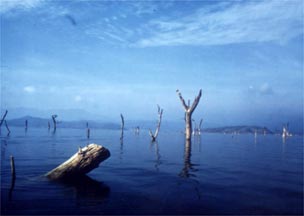 |
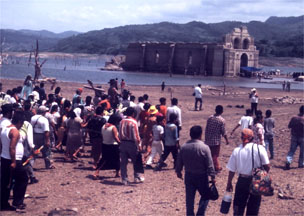 |
|
Many more photos at this website. |
|
|
|
|
| Extract:
Mexico: Rethinking
its Past by Mark Stevenson, AP via O.C. Register, 2-8-03 A dispute over a textbook questions how to present Mexico's history. The book in the center of the dispute is History of Mexico: An Analytical Approach by Claudia Sierra. Sierra's book states that the Mexican soldiers fired on student protesters in Mexico City on October 2, 1968. That statement, supported by witnesses and photographs, is almost universally accepted. It wouldn't be the first time that history texts have been the subject of heated debate in Mexico, where for decades students were taught by rote to memorize the names of national heroes and dates of battles - but seldom were encouraged to question the government policy. [The emphasis was a reflection of the political party's position.] The old texts painted the things in black and white. Some who criticized Sierra's book say they do not want to restore the old political myths - but do want to avoid new ones. |
| Family History Library
Catalog: Place Search
http://www.familysearch.org/eng/Library/fhlcatalog/supermainframeset.asp?display= Each of the following connects to a massive amount of
information. Mexico - Archives and libraries |
| Instituto
Nacional de Estudios Históricos de la Revolución Mexicana Con motivo de la presentación del libro Revolución y Diplomacia: México y España 1913-1917, de la doctora en Historia, Josefina Mac Gregor, quien es colaboradora y amiga de este Instituto, me permito enviarle esta invitación con los datos de la autora y del libro. A la presentación del libro se invitaron a especialistas en el tema para comentarlo, a saber: Eugenia Meyer, de la Facultad de Filosofía y Letras de la UNAM; Julio Montesino, agregado cultural de la embajada de España en México y Ricardo Pérez Montfort, director de la Revista Universidad de México. Presento el jueves 6 de febrero a las 18 horas, en la Sala de Lectura de la Biblioteca de la Revolución Mexicana, ubicada en Plaza del Carmen 27, San Ángel. Josefina Mac Gregor Gárate es licenciada, maestra y doctora en historia por la facultad de Filosofía y Letras de la UNAM, en donde también es profesora titular del Colegio de Historia; asimismo, desde marzo de 1999 ocupa el cargo de directora del Archivo Histórico y Memoria Legislativa del Senado de la República. Como especialista en la Revolución mexicana, ha escrito numerosos artículos en revistas, así como varios libros, entre los que se destacan: La XXVI Legislatura, un episodio en la historia legislativa de México, México y España del Porfiriato a la Revolución y México de su puño y letra. El sentir de un pueblo en las cartas al presidente. Ha sido merecedora en dos ocasiones, 1991 y 1999, del Premio de Investigación “Salvador Azuela” que otorga el INEHRM, y distinguida en varios periodos con la cátedra extraordinaria “Samuel Ramos” de la propia Facultad de Filosofía y Letras de la UNAM. El movimiento revolucionario iniciado en 1910 tuvo consecuencias en los más diversos ámbitos del orden jurídico en nuestro país, entre ellos las relaciones diplomáticas de México con el mundo, particularmente con España y Estados Unidos. Específicamente en el periodo que va de la caída de Madero a la consolidación de Venustiano Carranza como presidente, la colonia de inmigrantes españoles en México fue particularmente afectada en sus bienes y personas por los diferentes grupos revolucionarios, en tanto pudo catalizar algunos sentimientos ambivalentes, como una hispanofobia que recordaba la Conquista y una hispanofilia surgida en oposición al acendrado antiyanqui, herencia del siglo XIX. En este marco, tanto la embajada española como la norteamericana debieron realizar esfuerzos diplomáticos encaminados a negociar con los distintos grupos revolucionarios y con los diferentes gobiernos de facto que se iban sucediendo en nuestro país para salvaguardar los intereses de las colonias de extranjeros en México, en un momento de inestabilidad política dentro de un contexto internacional atribulado por la Primera Guerra Mundial. Con un agudo espíritu analítico y una vasta documentación bibliohemerográfica y de archivo, Josefina Mac Gregor analiza el desempeño de los diferentes actores que estuvieron involucrados en los problemas diplomáticos surgidos entre la colonia española residente en México, la representación diplomática de España y los personajes asignados por cada grupo revolucionario a la atención de las relaciones internacionales. Asimismo, nos ofrece información valiosa que permitirá entender mejor la perspectiva con la que en el extranjero se estaba observando a la Revolución mexicana. If need Genealogical Data please send your request to: mexicangenealogy@ancestros.com.mx Benicio Samuel Sanchez Ramon Lopez Velarde 729 Contry La Silla Guadalupe, Nuevo Leon 67173 Mexico Office Phone (81) 8387-5400 |
| CARIBBEAN AND CUBA | |
| More U.S. College Students Studying in Cuba | Exports to Cuba, a Boon for U.S. Farmers |
| Extract:
More U.S. college student
studying abroad in Cuba by Steve Giegerich, APO.C. Register, 1-3-03 Although Europe remains the top destination for U.S. college students studying abroad, more and more are choosing to enhance their education and exotic location close at home: Cuba. Long off-limits to all but a few American, Cuba allowed 900 and by U.S. students to visit during the 2000-2001 school year, a 64 % increase over the year before. The number is expected to grow the next time figures are released as students increasingly turned to the only Communist nation in the Western Hemisphere. "It's sort-of forbidden fruit," said University of Nebraska senior Shane Pekny, part of a contingent of 12 communications majors who will visited Cuba this month. Before its students and travel to Cuba, a school lmust obtain a license from the U.S. Treasury Department prohibiting the students from engaging in commercial enterprise during their visit. Each student must also obtained a visa from Fidel Castro's government. During their one week visit, Pekny and his classmates plan to studying such things as Cuba agriculture, the impact on Nebraska farmers should the U.S. trade embargo convicted, and the mechanical magic to the 1950s-vintage American cars on Cuba roads. |
| Extract:
Exports to Cuba, a Boon for U.S. Farmers by Brendan M. Case, The Dallas Morning News, via O.C. Register 1-18-03 American companies have signed contracts worth more than $250 million with Cuba since Congress began allowing food and agricultural exports in late 2001. Of that total, goods worth $210 million have been delivered and paid for. And total shipments to the communist-controlled Caribbean island could reach $1 billion within several years, despirte ongoing restrictions form the 40-year-old U.S. trade embargo. About 85 U.S. companies hailing from all over the United states have been involved in sending goods to Cuba. Nine American seaports have helped move the goods, and Cuba received 95 U.S. shipping deliveries last year, according to Cuban officials. Dennis Hays, of the Cuban American National Foundation, which vehemently opposes Castro, said "Everyone who has done business with Cuba now regrets it. Fidel Castro's regime owes billions of dollars to non-U.S. suppliers. However, U.S. law stipulates that farmers can only be paid in cash, giving Cuba little room to become a deadbeat debtor. |
| INTERNATIONAL | |
| Lusa Web,
a Portuguese-American Neighborhood Carlos Juan Finlay, M.D. Canary Islands Locales & Louisiana Families La Provincia Digital de Las Palmas Descendants of French Colonists of North America |
Links
Biblioteca Nacional de España Italian emigrants to US, Argentina & Brazil Institute of Filipino Studies Genealogía de Venezuela A Patron Saint for Hopeless Clickers |
|
|
||
|
|
A growing Database of passenger ship lists, where you can search for your Portuguese ancestors who left their homeland by ship. This database is an ongoing project started by LusaWeb with the help of many dedicated volunteers who spent countless hours transcribing these passenger ship lists. If you have extracted a Portuguese passenger ship list and would like to add it to our archives, or would like to participate in the project, please contact us at Webmaster@lusaweb.com |
|
Carlos Juan Finlay, M.D. by
Elias Padilla
In medicine, Dr. Walter Reed is generally credited with originating the theory of yellow fever transmission by mosquitos. The truth is that he only confirmed this theory. Carlos Juan Finlay, a modest Cuban physician, was the one who actually originated it. Up until the time that Dr. Finlay began his research into yellow fever, the medical research profession worldwide believed this disease was transmitted through the air or produced by a putrid substance from dead marine organisms. In 1879, Dr. Finlay suspected this theory was wrong and began his research, which lasted two years, after which his findings convinced him that yellow fever was transmitted by mosquitoes. For the next 22 years, American scientists, including Dr. Reed, repeatedly rebuffed Finlay's attempts to convince them that his theory was correct. During this period, yellow fever killed more American soldiers than died in the Spanish-American War and claimed the lives of 52,000 French workers constructing the Panama Canal. It wasn't until 1901 that the American scientists, following the lead of their colleagues in Mexico, Cuba and Europe, finally confirmed Dr. Finlay's theory. One can only wonder how many lives would have been saved if more people had listened to him earlier. In 1933, the world paid homage to Finlay in
Dallas, Texas, when leaders of medicine from the Western Hemisphere named
December 3, his birthday, as the "Day of American Medicine." |
| CANARY
ISLANDS LOCALES AND THEIR ASSOCIATED LOUISIANA FAMILIES http://freepages.genealogy.rootsweb.com/~brasscannon/locales9.html Compiled by: Paul Newfield III pcn01@webdsi.com 3016 45th Street Metairie, La. USA 70001 This compilation is a finding aid to help document the islands and villages from which our Canarian ancestors came. The present work is a refinement and expansion of two earlier articles: "Some Canary Island Locales and Their Associated Louisiana Families (Based upon Diocese of Baton Rouge's published records, volume 2)", by Paul Newfield III, published in Louisiana Genealogical Register (the quarterly of the Louisiana Historical Society), v.35, #1 (March 1988), pp.23-26, and, "More Canary Islands Locales and Their Associated Louisiana Families (From the Archdiocese of New Orleans Sacramental Records, volumes 3 & 4)", by Paul Newfield III, published in 'L'Heritage' (the quarterly of the St. Bernard Genealogical Society), v.13, #50 (April 1990), pp.118. The scope of this article is limited, and it should NOT be taken as a complete listing of Canarian family names. In each of my earlier articles I began with the seven major islands of the Canarian archipelago, listing their particular towns and villages. Then, using the geographic data from the published sacramental records of the Diocese of Baton Rouge and from the Archdiocese of New Orleans, I assigned those family names to the respective islands and/or villages. In attributing a certain family name to a certain island or village, I have been very careful to provide at least one specific citation to that effect. Those books are cited as "BR 2" (1770-1803), "SRNO 3" (1772-1783), and "SRNO 4" (1784-1790) respectively (see References). This compilation covers most of the settlement areas in Louisiana where the newly arrived Isleños established themselves: New Orleans, Barataria (in Jefferson Parish), Terre aux Boeufs (Tierra de Bueyes in St. Bernard Parish), Valenzuela (along Bayou La Fourche in Assumption and Ascension Parishes), and Galveztown (in Ascension Parish). The three source books for this report do not cover the area of New Iberia, where some Isleños may have settled in c.1779, along with the Malagueños from southern Spain. Consequently, that area is NOT addressed by this report. A further note: In compiling these lists, I disregarded any entry from the published sacramental records that gave no specific geographic information other than the words "... of the Canary Islands". Consequently, this listing will NOT include all Canary Islands families who came to Louisiana. It lists ONLY those that have been specifically associated with any particular island, town or village. Use your computer's Control - F function to quickly find any name (surnames only). After locating the respective name(s), you should consult the original record as cited. THE ISLANDS AND THEIR VILLAGES The Canarian archepelago consists of two governmental provinces, La provincia de Santa Cruz de Tenerife in the west, and La provincia de Las Palmas in the east, each with its own governmental administration. The same division applies also to ecclastical administration, with the Western Islands' Diocese of San Cristobal de La Laguna (est. 1819), and the Eastern Islands' Diocese of the Canary Islands (est. 1406). Tenerife Gran Canaria La Gomera Fuerteventura La Palma Lanzarote El Hierro (Graciosa) Sent by Bill Carmena JCarm1724@aol.com |
| La
Provincia Digital, La Provincia, Diario de Las Palmas http://www.editorialprensacanaria.es/prensib.htm Information on the Canary Islands. Includes links to 13 newspapers. Sent by Bill Carmena Good website. JCarm1724@aol.com |
| New
France Genealogy for descendants of the French Colonists of North
America http://home.primus.ca/~lmrobert/index.html Sent by Johanna De Soto This site provides tidbits of information about colonists of New-France and their descendants from 1534 to 1899, in the form of passenger lists, places of origin, activities, maps, military rolls, people who took part in some historical events,etc. This may help learning about your ancestors. Michel Roberts the web master has provided links to the following: 1 - Bits and pieces on the LAVALLÉE ANCESTORS 2 - Ships landed in Canada from 1633 to 1663 3 - Ships landed in Canada from 1664 to 1713. 3a - Ships landed in Canada from 1714 to 1763. 4 - The seven ships of the Carignan-Salières Regiment, 1665. 4a - The Brézé, a ship of the Carignan-Salières Regiment.1665. 5 - Roll of the Sorel Company in 1760 during the Seven Years War. 6 - The Passengers List of the Saint-André in 1659. 7- List of Militia Captains in 1775 for the area of Quebec City. 8 - List of Veterans of the War of 1812 who received a gratuity in 1875. 9 - Some regulations enacted in Montreal in 1676 10 - Roll of the Carignan-Salières Regiment in 1668. 11 - Passengers and crews of Jacques Cartier, Second voyage to Canada, 1535. 12 - Crew of the Christophe from La Rochelle to North America, 1535. 13 - Irish Deserters in Canada, 1757. 14 - Land concessions in Saurel (Sorel) and part of Seigneurie de Yamaska in 1723. 15 - Value of Currencies in Nouvelle - France in 1663-1670. 16 - Horse owners in Nouvelle-France in 1681. 17 - 1058 arrests during the 1837-1840 period in Lower Canada. 18 - 44 engagement contracts for Canada at La Rochelle in 1642. 19 - 196 acts from notary Becquet 1667-68, Québec |
| Links
to the resources of the Biblioteca Nacional de España .......Sent
by Johanna De Soto Ministerio de Educacion Cultura y Deporte: http://www.bne.es/esp/indice-fra.htm Acceso y Horario Agenda y Noticias Biblioteca Nacional Catálogo de Publicaciones en Venta Catálogos Cooperación Internacional Exposiciones Virtuales Punto Focal Español Recursos de Interés Bibliotecario Relación de Servicios Salas de Consulta La Biblioteca Nacional de España es el
principal centro informativo y documental sobre la cultura escrita
española e hispanoamericana por ser la institución depositaria de las
publicaciones impresas en el territorio español desde comienzos del
siglo XVIII recibidas a través del Depósito Legal. |
| The
data banks on Italian emigrants to the Untied States, Argentina and
Brazil http://www.italians-world.org/Italy/BancaDatiGb.htm Sent by Johanna De Soto The Centro di documentazione sulle popolazioni e le culture italiane nel mondo (Center for Documentation on Italian populations and cultures in the world), set up by the Giovanni Agnelli Foundation in 1993, offers three separate data banks containing the transcription of the information contained in the passenger lists of the ships that arrived in New York, Buenos Aires and Vitoria, (Italian nationals only) |

INSTITUTE
OF FILIPINO STUDIES
|
| Genealogía
de Venezuela http://www.geocities.com/Heartland/Ranch/2443/ We have made our best efforts to present the genealogical resources available by state in a clear and precise way. If you discover a mistake or have information you would like to contribute, please send us a message via e-mail or leave us a note in our guest book. We have heavily relied on the information on states found in "Atlas Práctico de Venezuela" published by the newspaper El Nacional and cartografía Nacional, which describes the changes in the state frontiers. I'd like to take the opportunity to thank Elvira Perez, Aleyda Vegas y Miriam Bocanegra de Montaña for their help and support with materials and many ideas. Thank you and enjoy your research! Sent by Johanna De Soto |
| A
Patron Saint for Hopeless Clickers [[Editor's note: This was so interesting, the article is in its entirety.]] Vatican Turns to Cyberspace in Its Search for Protector of Users of the Internet by Daniel Williams, Washington Post Foreign Service Wednesday, January 29, 2003; Page A17 http://www.washingtonpost.com/wp-dyn/articles/A58076-2003Jan28.html ROME -- The Archangel Gabriel is one of Christianity's great communicators -- it was he who brought word to Mary that she would give birth to Jesus, the Bible says. So it was only natural that when a search began for a patron saint for the Internet, Gabriel's name arose. According to a poll being conducted by a Roman Catholic organization in northern Italy, he is now in sixth place behind a 20th century martyr, an educator and a publisher born in the 19th century, an 18th century evangelizer and a 13th century nun who saw visions projected on a wall. The web site, www.santiebeati.it, is soliciting votes with the aim of having an Internet patron saint named by Easter. "We had lots of requests for a patron, so we decided the Internet was the best tool for finding one," said Roberto Diani, an Internet adviser for Italy's Conference of Bishops. The official choice will be made by the Vatican's Congregation for Divine Cult and Discipline of Sacrament. For all the new-fangled methodology, the organizers are following an ancient tradition. For hundreds of years, Christians in villages, towns and cities got together and proclaimed a saintly hero and protector. Later, popes set the rules for sainthood, but nominations still came from the field. Now, in the name of professions and causes never imagined a millennium ago, Catholics are still lining up patron saints. Recently, motorcyclists got their own patron saint, endorsed by the Vatican -- St. Columbanus, a medieval Irish monk who walked through Europe setting up monasteries. He ended up in Bobbio, Italy, and cyclists there lobbied for him as protector. Pope John Paul II has named patron saints to promote religious instruction among key professions. In October 2000, he declared St. Thomas More the patron saint of politicians. More was a friend of King Henry VIII, but opposed the monarch's divorce, which resulted in the creation of the Church of England and his self-appointment as its head, precipitating England's break with Rome. In John Paul's view, More sets an example for politicians to be true to religious convictions in setting policy. Recently, he cited More when asking Catholic politicians to oppose abortion. The patron saint hunt is a subset of a boom in saint recognition under John Paul II's reign. These days, saints aren't so much marching as flooding in. During the past quarter century, John Paul has presided over 465 canonizations, the formal declarations that recognize full-fledged saints, and 1,297 beatifications, the designation of "blesseds" who stand on a rung just below sainthood. That compares with 447 canonizations and 1,310 beatifications during the preceding 400 years. In one day, John Paul beatified 233 nuns, priests and lay people killed by Republican forces during the Spanish Civil War. "This is a popular tradition in full bloom, to say the least," said Severio Gaeta, an expert on sainthood at the Catholic magazine Famiglia Cristiana. There will be no slowdown this year. The pope is scheduled to set about 30 people on the road to sainthood. The most widely known, Mother Teresa of Calcutta, will be beatified in October. She spent her life tending to the dying in India. Her mission strikes a particular chord for this ecumenical pope: she hailed from Albania, a mostly Muslim country, and ministered in a country overwhelmingly Hindu. He also plans to beatify an Italian priest, Marco d'Aviano, who rallied Christian forces to defend Vienna during a 17th century siege by invading Turks. Europeans consider the defense of Vienna a landmark in history: It reversed the Muslim advance into Europe. Some Italian commentators have warned that d'Aviano's elevation might offend Muslims at a time when "war of civilizations" is invoked by some to explain the battle against Islamic-based terrorism. This year, the pontiff will beatify a 19th century missionary who worked in China and a bishop who labored in Sudan. These moves come when the pope has been trying to restore Rome's control over the Catholic Church in China, where the Communist Party usurped the papal prerogatives and created its own Patriotic Church. Sudan has suffered years of a Muslim-Christian civil war. Vatican officials reject notions that politics plays a role in saint selection. "There's speculation, but the list is so varied, who can really say so?" said Msgr. Robert Sarno, who works in the Congregation for the Cause of Saints, the Vatican office in charge of vetting candidates for sainthood. The pope evidently regards the making of saints as a teaching aid. During the millennium celebrations in 2000, he praised saints as "a message that convinces without the need for words." Sometimes, the message is not clear to everyone. Last year, John Paul beatified a predecessor, Pope Pius IX, best known in Italy for repression of supporters of constitutional rule in central Italy and for endorsing the removal of a Jewish child, Edgardo Mortara, from his family because he had been secretly baptized. The pope alluded to Pius's transgressions, saying, "The Church does not celebrate particular historical choices he made, but rather singles him out for imitation and veneration for his virtues." The Vatican credits Pius with the miraculous cure of a lame nun. Early Christians reserved sainthood for martyrs. Christianity was outlawed during more than three centuries of Roman rule. It had spread from the Holy Land over what, at the time, was the equivalent of the Internet: Roman roads. Christians were frequently executed for practicing their faith. Such bloody qualification for sainthood faded under Emperor Constantine, who declared Christianity the empire's official religion. In the 4th Century, the standard for sainthood shifted to holiness. "Virtue was an heroic act," said Sarno. "Saints were people to be imitated, to find a way to live the message of Christ." Thirty years ago, the pantheon of saints endured a housecleaning. Saints whose worth seemed based on legend rather than historical fact were eliminated. A venerable Italian favorite, St. Philomena, was erased from the official calendar of saints days because her following was based on a tombstone inscription attesting to her virtue. It turns out that many Roman-era women's tombs bore such praise. St. Christopher, the traditional patron of travelers, met a similar fate. The tale that he carried the child Jesus across a river was deemed apocryphal. Taxi drivers throughout the Catholic world suddenly found they were putting their safety in the hands of someone the church didn't recognize. Among the personages set for beatification this year is San Giacomo Alberione, founder of a major Catholic publishing house. He also leads the Internet patron race with 29 percent of the vote. The others in the top six are Gabriel, St. John Bosco, founder of the Salesian order and a promoter of youth education; Sant'Alfonso Maria de Liguori, a bishop and prolific writer; and Maximilian Kolbe, a Polish priest and missionary who favored use of technical advances to spread the Gospel. He died of hunger in Auschwitz after offering his life in exchange for a condemned fellow prisoner. Finally, there's St. Clare of Assisi, who saw visions on the wall; she's the patron saint of television. Individual groups can put in for patrons. Whether or not Gabriel climbs in the Santiebeati poll, he might be pleased to know that he was named recently by the Vatican as patron saint of telecommunications officers in the armies of Colombia and El Salvador. © 2003 The Washington Post Company |
| HISTORY | |
| Abraham Lincoln and Prayer American Forts West: Mexico |
"Guess Who Fought in the War Between the States (Civil War)? Many, Many Hispanic Confederates!" |
|
| ARCHAEOLOGY | |
| Dam to flood Maya Ruins Ancient tablet echoes Bible passage |
Fossil Hunters Turn-up Sea Monster in Mexico |
| Dam to
flood Maya Ruins http://www.archaeology.org
Go to URL site for more information. Evidence continues to surface that a hydroelectric dam proposed by Mexico's Federal Commission of Electricity (CFE) will flood an area of southeastern Mexico rich in Maya ruins and artifacts. Archaeologists working in the Usumacinta River basin--many of whom are advisers to the electricity commission--have established that the dam would inundate a largely unexplored area near the Guatemalan border they believe to have been the seventh-century Maya kingdom of Ponomá. Adding to the public relations fallout for CFE was the recent discovery of remarkably well-preserved cave paintings at a lesser-known site called Chinikiha, which lies well within the proposed flood area. This is the third time since 1987 that the Mexican government has made plans to dam the Usumacinta, which is the longest river in Mesoamerica and the most torrential in Mexico. Attempts by Mexican presidents Miguel de la Madrid in 1987 and Carlos Salinas in 1992 met with stiff civic resistance and were canceled. This latest version is planned for the same location as its predecessors, 5.5 miles south of Tenosique, where the river rushes northward out of the Chiapas highlands en route to the coastal plain of Tabasco. The site is known as Boca del Cerro, or Mouth of the Hill. Although the presence of archaeological ruins in the area has long been suspected, dense jungle cover and a shortage of government funds for exploration have combined to leave its contents largely unknown. Between A.D. 600 and 800 the region flourished as Pomoná, a kingdom whose strategic location on the Usumacinta brought it into many confrontations with powerful neighbors in Palenque to the west and Piedras Negras to the south. Boca del Cerro and the proposed dam site was once a Pomoná settlement known as Panhale. Newspapers around the world sounded the alarm, including the New York Times, which quoted archaeologist Stephen D. Houston, who works at Piedras Negras, proclaiming the proposed dam "the biggest disaster ever to be visited on a classic Maya site." The CFE promptly revised its plan, announcing before the Mexican Congress on October 7, 2002, their intent to build a dam 132 feet high that would flood approximately 22 square miles of land, and would generate 500 megawatts of electricity, fulfilling two percent of Mexico's total need. For his part, López Wario, who directs INAH's archaeological salvage project, told Proceso that there are 25 unexplored archaeological zones near the proposed dam site. He said that while the high-profile sites of Piedras Negras and Yaxchilán will likely be protected, lesser-known sites like Chinikiha are faced with destruction. |
| Extract:
Ancient tablet echoes Bible
passage http://www.msnbc.com/news/858803.asp?cp1=1 JERUSALEM, Jan. 13 — Israeli geologists said Monday they have examined a stone tablet detailing repair plans for the Jewish Temple of King Solomon that, if authenticated, would be a rare piece of physical evidence confirming biblical narrative. The find — whose origin is murky — is about the size of a legal pad, with a 15-line inscription in ancient Hebrew that strongly resembles descriptions in the Bible’s Book of Kings. The tablet could also strengthen Jewish claims to a disputed holy site in Jerusalem’s Old City that is now home to two major mosques. Muslim clerics insist, despite overwhelming archaeological evidence, that no Jewish shrine ever stood at the site. That claim was made by Palestinian officials in failed negotiations with Israel in 2000 over who would be sovereign there. The origin of the stone tablet is unclear, making it difficult to establish authenticity. The sandstone tablet has a 15-line inscription in ancient Hebrew that resembles descriptions in Kings II, 12:1-6, 11-17, said Israel’s Geological Survey, which examined the artifact. The words refer to King Joash, who ruled the area 2,800 years ago. In it, the king tells priests to take “holy money ... to buy quarry stones and timber and copper and labor to carry out the duty with faith.” If the work is completed well, “the Lord will protect his people with blessing,” reads the last sentence of the inscription. The Jerusalem collector has declined to come forward, and David Zailer, a lawyer for the collector, would not say where the tablet was found or give any further details. Shimon Ilani, who performed geological tests on the inscription confirms through carbon dating that the writing goes back to the 9th century, B.C. Sent by Armando Montes amontes@mail.com |
| Extract:
Fossil Hunters Turn Up 50-ton
Sea Monster in Mexico By Allan Hall in Berlin and Mark Henderson, Science Correspondent http://www.law.cornell.edu/uscode/17/107.shtml A COMPLETE skeleton of the largest predator of all time, a Jurassic sea monster that made Tyrannosaurus Rex look like a featherweight, has been discovered in Mexico. The fossilized bones, measuring 65 feet from nose to tail, have been identified as those of Liopleurodon Ferro, a fearsome carnivore that terrorized the oceans 150 million years ago. The marine behemoth, which was featured in the BBC series Walking With Dinosaurs, boasted teeth the size of machetes packed into 10 ft jaws powerful enough to bite through granite. It weighed more than 50 tons "seven times larger than T. Rex" and hunted the ancestors of modern sharks and aquatic reptiles such as ichthyosaurs. Had the species lived at the same time, it would have been capable of killing a blue whale. Although the existence of Liopleurodon Ferro has been known since the 19th century, through partial fossils, the new specimen, found by German and Mexican paleontologists, is the first recovered in its entirety. Analysis of the skeleton, which is nicknamed the "monster of Aramberri" after the site in northeastern Mexico where it was found, is expected to reveal details of the Liopleurodon's last meal and the cause of its death. The skull, as large as a car, has a huge hole in it, possibly made by a victim that fought back. The bones were discovered mingled with those of smaller ichthyosaurs, which the Liopleurodon had probably eaten, together with huge chunks of rock which it would have swallowed along with its prey as an aid to digestion or as ballast. Eberhard Frey, of the Natural History Museum in Karlsruhe, who led the research team, said the specimen would allow them to reconstruct the most accurate model yet of the creature. "This is the world's first complete example of the species and therefore it is a sensational find," he said. "No other living creature in the sea could fight it successfully. They swallowed prey whole. "This is the largest specimen of any dinosaur ever found. Now we have this one unique chance to reconstruct this creature, to show it how it was. Now we can learn so much about the way these behemoths of the deep lived." |
|
Interesting
Facts, History is not boring. |
I've Learned. . . |
| Interesting
Facts: The next time you are washing your hands and complain
because the water temperature isn't just how you like it, think
about how things used to be. Here are some facts about the
1500s: Most people got married in June because they took their yearly bath in May and still smelled pretty good by June. However, they were starting to smell so brides carried a bouquet of flowers to hide the body odor. Hence the custom today of carrying a bouquet when getting married. Baths consisted of a big tub filled with hot water. The man of the house had the privilege of the nice clean water, then all the other sons and men, then the women and finally the children-last of all the babies. By then the water was so dirty you could actually lose someone in it. Hence the saying, "Don't throw the baby out with the bath water." Houses had thatched roofs-thick straw-piled high, with no wood underneath. It was the only place for animals to get warm, so all the dogs, cats and other small animals (mice, bugs) lived in the roof. When it rained it became slippery and sometimes the animals would slip and fall off the roof. Hence the saying "It's raining cats and dogs." There was nothing to stop things from falling into the house. that posed a real problem in the bedroom where bugs and other droppings could really mess up your nice clean bed. Hence, a bed with big posts and a sheet hung over the top afforded some protection. That's how canopy beds came into existence. The floor was dirt. Only the wealthy had something other than dirt. Hence the saying "dirt poor." The wealthy had slate floors that would get slippery in the winter when wet, so they spread thresh (straw) on the floor to help keep their footing. As the winter wore on, they kept adding more thresh until when you opened the door it would all start slipping outside. A piece of wood was placed in the entranceway. Hence the saying a "thresh hold." In those old days, they cooked in the kitchen with a big kettle that >always hung over the fire. Every day they lit the fire and added things to the pot. They ate mostly vegetables and did not get much meat. They would eat the stew for dinner, leaving leftovers in the pot to get cold overnight and then start over the next day. Sometimes the stew had food in it that had been there for quite a while. Hence the rhyme, "Peas porridge hot, peas porridge cold, peas porridge in the pot nine days old." Sometimes they could obtain pork, which made them feel quite special. When visitors came over, they would hang up their bacon to show off. It was a sign of wealth that a man "could bring home the bacon. "They would cut off a little to share with guests and would all sit around and "chew the fat." Those with money had plates made of pewter. Food with high acid content caused some of the lead to leach onto the food, causing lead poisoning and death. This happened most often with tomatoes, so for the next 400 years or so, tomatoes were considered poisonous. Bread was divided according to status. Workers got the burnt bottom of the loaf, the family got the middle, and guests got the top, or "upper crust." Lead cups were used to drink ale or whisky. The combination would sometimes knock them out for a couple of days. Someone walking along the road would take them for dead and prepare them for burial. They were laid out on the kitchen table for a couple of days and the family would gather around and eat and drink and wait and see if they would wake up. Hence the custom of holding a "wake." England is old and small and the local folks started running out of places to bury people. So they would dig up coffins and would take the bones to a "bone-house" and reuse the grave. When reopening these coffins, 1 out of 25 coffins were found to have scratch marks on the inside and they realized they had been burying people alive. So they thought they would tie a string on the wrist of the corpse, lead it through the coffin and up through the ground and tie it to a bell. Someone would have to sit out in the graveyard all night (the "graveyard shift") to listen for the bell; thus, someone could be "saved by the bell" or was considered a "dead ringer." And that's the truth... Now , whoever said that History was boring ! ! ! ! ! Educate someone...Share these facts with a friend... Sent by Bill Carmena |
| Friends
. . . I've learned.... That life is like a roll of toilet paper. The closer it gets to the end, the faster it goes. I've learned.... That we should be glad God doesn't give us everything we ask for. I've learned.... That money doesn't buy class. I've learned.... That it's those small daily happenings that make life so spectacular. I've learned... That under everyone's hard shell is someone who wants to be appreciated and loved. I've learned.... That the Lord didn't do it all in one day. What makes me think I can? I've learned.... That to ignore the facts does not change the facts. I've learned.... That when you plan to get even with someone, you are only letting that person continue to hurt you. I've learned.... That love, not time, heals all wounds. I've learned.... That the easiest way for me to grow as a person is to surround myself with people smarter than I am. I've learned.... That everyone you meet deserves to be greeted with a smile. I've learned.... That there's nothing sweeter than sleeping with your babies and feeling their breath on your cheeks. I've learned.... That no one is perfect until you fall in love with them. I've learned.... That life is tough, but I'm tougher. I've learned.... That opportunities are never lost; someone will take the ones you miss. I've learned..... That when you harbor bitterness, happiness will dock elsewhere. I've learned.... That I wish I could have told my Dad that I love him one more time before he passed away. I've learned.... That one should keep his words both soft and tender, because tomorrow he may have to eat them. I've learned.... That a smile is an inexpensive way to improve your looks. I've learned.... That I can't choose how I feel, but I can choose what I do about it. I've learned.... That when your newly born child holds your little finger in his little fist, that you're hooked for life. I've learned.... That everyone wants to live on top of the mountain, but all the happiness and growth occurs while you're climbing it. I've learned ... That it is best to give advice in only two circumstances; when it is requested and when it is a life threatening situation. I've learned.... That the less time I have to work with, the more things I get done. Sent by Bill Carmena |
12/30/2009 04:48 PM